first my video day 3 – 6 (CP1 – Ferry Ystad):
Wed, 22 July – still Day 3, Parcours 1(b)
Only later will I learn that more than 60 riders failed to reach CP1 in time, after more than 700 kilometres. How frustrating that must be: months of training, and then you’re out of the race after just 700 kilometres. I certainly can’t afford to rest on my laurels, though. So I keep going. I still have more than 50 kilometres ahead of me, with almost 1,700 metres of climbing – and almost all of it on gravel. This was the part of the event I had worried about most beforehand. How quickly would I be able to get through it? I had absolutely no idea. Would it take around seven hours, or perhaps more than ten? What I would really have liked by now was one “comfortable” night in a hotel bed. Preferably in Geilo, about 50 kilometres beyond the end of the parcours. Which means I still have more than 100 kilometres to go.
First, eight kilometres of climbing on asphalt. Almost immediately, I have a near miss: a woman on an e-bike and without a helmet comes hurtling towards me on my side of the road. She doesn’t brake. Somehow we manage to squeeze past each other without a head-on collision. Presumably someone from the cruise ship, riding a bike for the first time in her life. I’m on alert now.
Cyclists keep coming towards me, some of them flying downhill at considerable speed. There must be a “nest” somewhere … For me, this means keeping as far to the right as possible on the narrow road. Apparently, many people don’t expect anyone to be cycling uphill here. Children fool around on their bikes, people stare at their smartphones while riding, others ride two abreast. The landscape, however, is wonderful: a green, wooded valley stretching further and further uphill. And somewhere I keep hearing a train. Could that have something to do with the hordes of cyclists?
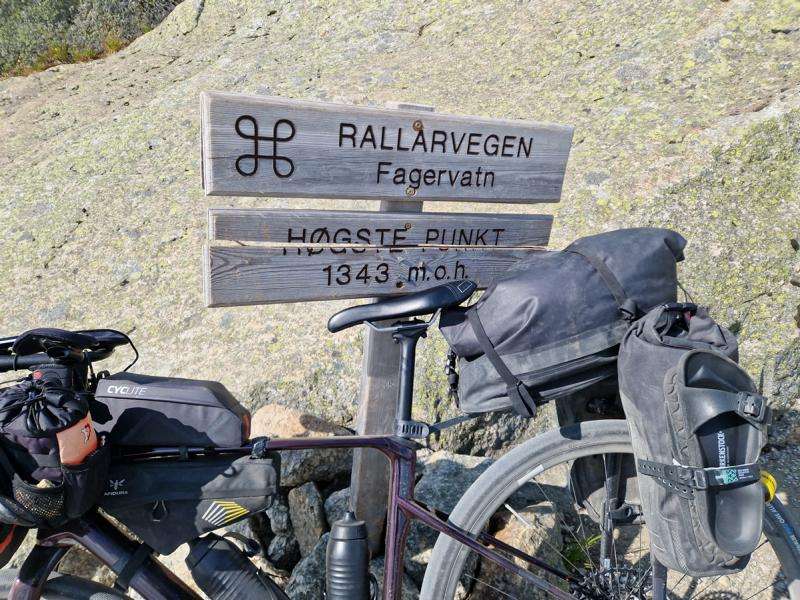
Well, the Rallarvegen is Norway’s most famous cycling route after all. The gravel road was built in the early 20th century during construction of the Bergen Railway, originally for transporting materials by horse. Today it is a spectacular cycling route through the stark high-mountain landscape between Haugastøl and Flåm. Around 80 kilometres of gravel, snowfields, waterfalls and steep mountain slopes, with the highest point at about 1,340 metres.

But the cyclists coming towards me have no luggage, and many of them are even riding identical bikes. The mystery is solved further up: hundreds of bicycles are lined up outside a mountain lodge. The riders have taken the historic Flåmsbana railway up the mountain and are now cycling back down. Aha! From here on, at least, I no longer have to worry about being run over. Only a few cyclists come towards me now – and these, loaded down like me, are presumably actually riding the historic Rallarvegen.
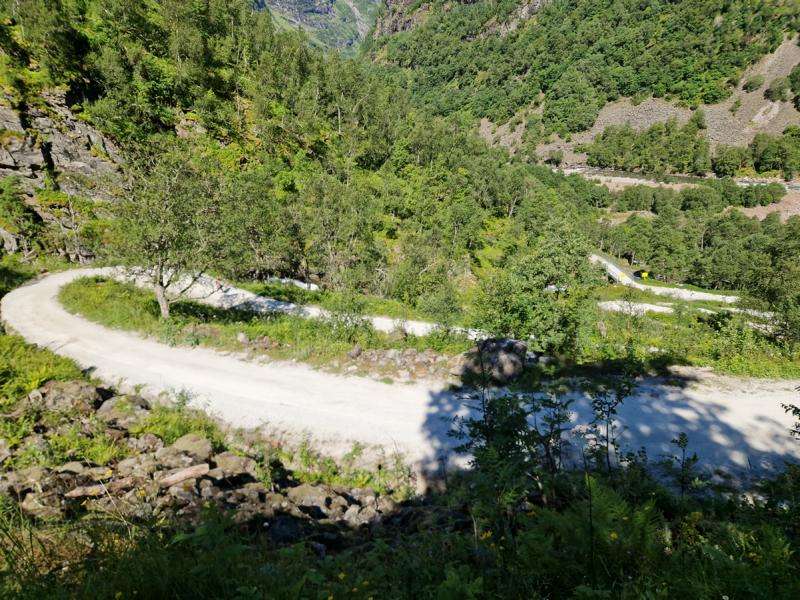
Now I reach the 21 hairpin bends I already know from my route planning. In just a few kilometres, 300 metres of elevation have to be gained, with gradients of up to 18–20 percent. My plan of simply grinding my way up is quickly abandoned. I push. Along with several others behind me. And as I push, I get annoyed with my Garmin once again claiming that the gradient is 0 percent. Apparently I’m moving so slowly that the device thinks I’m standing still.
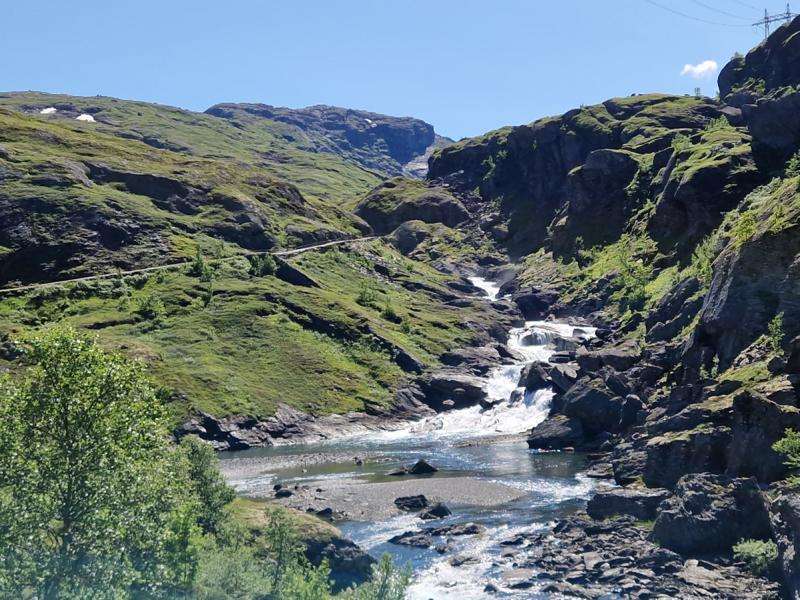
At the top, the landscape opens into a broad valley. After passing the mountain station of the zipline, where the brave ones throw themselves into the depths in groups of three, things become quieter. My route, however, continues steadily uphill. I pass wonderfully blue lakes and rushing streams and can hardly stop myself from looking around and taking photos. Taking pictures while riding would be rather foolish, though. The route follows the historic, narrow access road and is sometimes barely wide enough for two bikes to pass. The surface also slopes away from the centre towards the edge. Extreme caution is required, because in places the road even runs along a stone wall. A long way down!
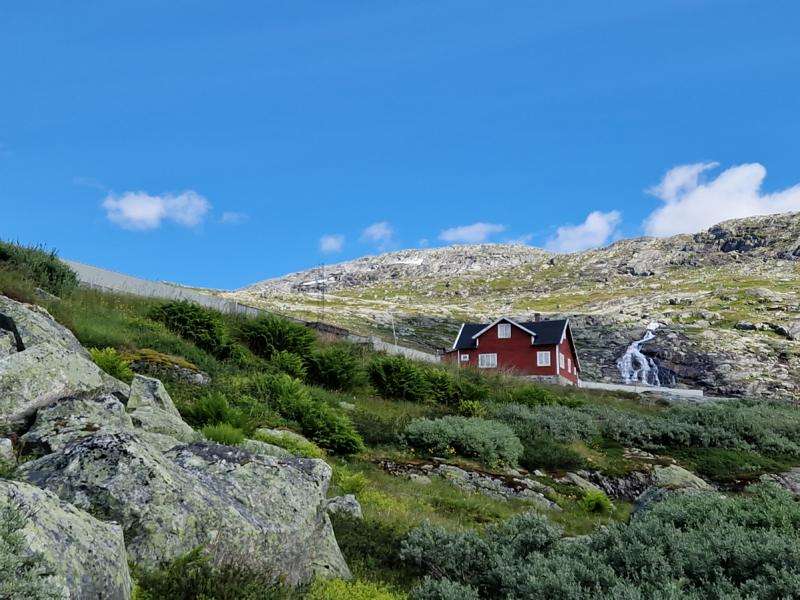
The gradient is mostly moderate, with one short ramp after another. At some point I finally think I must be at the top. But of course, one steep section follows another. Patches of snow show that winter hasn’t been gone for long up here. I stop for a break on a little stone wall and eat mozzarella with tomatoes. A few riders pass me. Damn, there go a few more places! Just kidding – positions mean absolutely nothing here. A later look at the live-tracking platform, where we can all follow each other via our trackers, will show me that most of the riders who were somewhere around me at this point never made it to the finish.
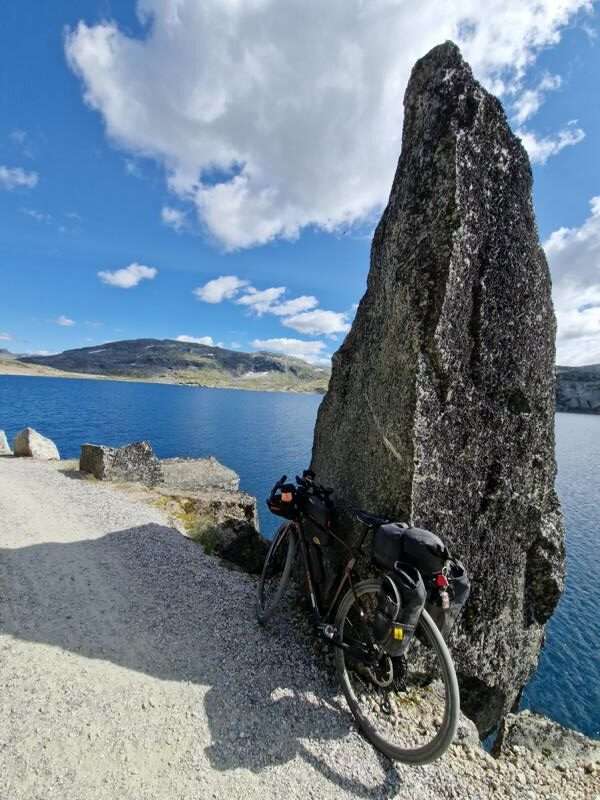
After countless moments of thinking I have finally reached the highest point, I eventually really do. After more than 1,600 metres of climbing over fairly demanding terrain and with 22 kilos of luggage including the bike, I’m standing at more than 1,300 metres above sea level. Snow and ice all around – I feel almost as if I’m back in the high mountains at home.
The descent to Finse, which I had been looking forward to, demands total concentration. The trail is mostly in pretty poor condition, with washed-out bumps, potholes and all sorts of other surprises. You have to be ready to slam on the brakes at any moment if you don’t want to take an unscheduled shortcut into the wilderness – bike and luggage included.
Further down, I spot a rider sitting several metres below the trail. What on earth? Why has he taken his bike down there? I stop and ask if everything is okay. It isn’t. He has gone over the wall. For David, the race ends here after 740 kilometres – with a broken hip, as I will learn later. I ask if I can help, but someone is already on their way to get help around the next bend, where there is mobile reception. So I continue. Shortly afterwards, a woman arrives on a quad bike. Help is quickly on its way, although she knows nothing about the accident. I never find out how David gets to hospital. The incident brings back a shuddering memory of our drama at the Silkroad Mountain Race last year.
Soon I reach Finse. There is nothing left to eat; the kitchen has already closed. So my biscuits have to do. Then I roll on. And, against all expectations, I can actually pick up some speed: 25 kilometres of good gravel road downhill.
An aside: Over the last few days I’ve repeatedly seen energy-bar and gel wrappers, cable ties and all sorts of other bits of rubbish lying by the roadside. Who deliberately does that? We cyclists, to save weight. I certainly don’t. Although … yesterday I did throw something away and didn’t pick it up again. My GoPro. I could still cry over all those lost images. Well, at least the first video won’t be quite as long.
Back on a proper road, in Haugastøl, the small mountain village on the edge of the Hardangervidda, I meet Zuska. She is completely distraught. She doesn’t know what to do: her passport, wallet and tracker – everything is gone. Only when she starts telling the story from the beginning do I understand what has happened. She left her hydration pack somewhere near Finse. Poor thing. Unfortunately, there is nothing I can do to help. On Followmychallenge I can at least see that Zuska should still be somewhere before Finse. And there it is – her backpack!
She manages to get herself out of the mess. She misses the next checkpoint cut-off by a little and arrives too late, but she doesn’t let it get her down. General Classification or not, she keeps riding and makes it to the finish. It’s her first ultra race – and she has chosen one of the toughest ones out there. Impressive.
I try to book a hotel in Geilo. No chance. Everything is fully booked. Well, there is one room available for a few thousand euros. That’s a little beyond my budget. So now what? It’s too cold to camp up here. I ask at Hotel Haugastøl whether they might have a bed for me. And, against all expectations: they do!
I even get a pizza, some powdered hot chocolate for breakfast, and two little cinnamon buns are given to me as a gift. Luxury! And a little detail on the side: I’ve already cycled past here twice before, during my Norseman triathlons. The small village isn’t far from the starting point in Eidfjord.
I charge all my devices. The tracker goes on charge too. But the next morning it doesn’t seem to have charged much further. Stress. Is there something wrong with the cables? Where am I going to find a new one?
Before falling asleep, I work out how much earlier I’ll have to start the next morning if I want to reach Geilo on schedule – my originally planned starting point for the day. The answer: two hours earlier out of bed.
Serves me right.
Thu, 23 July – Day 4
So, I’m back on the road at half past three. The warmth of the bed doesn’t last long, though, and soon I have to stop again. One look at my Garmin tells me why I’m freezing: just 4°C. Gloves – all three pairs layered on top of each other –, wind jacket, hood pulled over my head, and off I go, shivering. The mist rising from the landscape seems to underline the cold. Fortunately, there’s a climb after Geilo. I can’t remember ever being quite so happy to gain a few metres of elevation.

Relieved, I check the tracking platform and see that my tracker did actually charge. Perhaps it was still in sleep mode in the morning and hadn’t yet connected to the satellites.
My next concern is food. Where will I get something to eat? The next almost 300 kilometres to the ferry in Horten, south of Oslo, will take me through a remote landscape of forests and lakes.
Most riders are taking the main road further west, as I can see from time to time on Followmychallenge. And I’m relieved to see that Zuska apparently has her backpack back, because her tracker shows her in Haugastøl. I end up on this main road a few times myself. The traffic is horrible! I’m all the happier whenever I can get back onto a quiet side road – even if it means taking on a few extra metres of climbing.
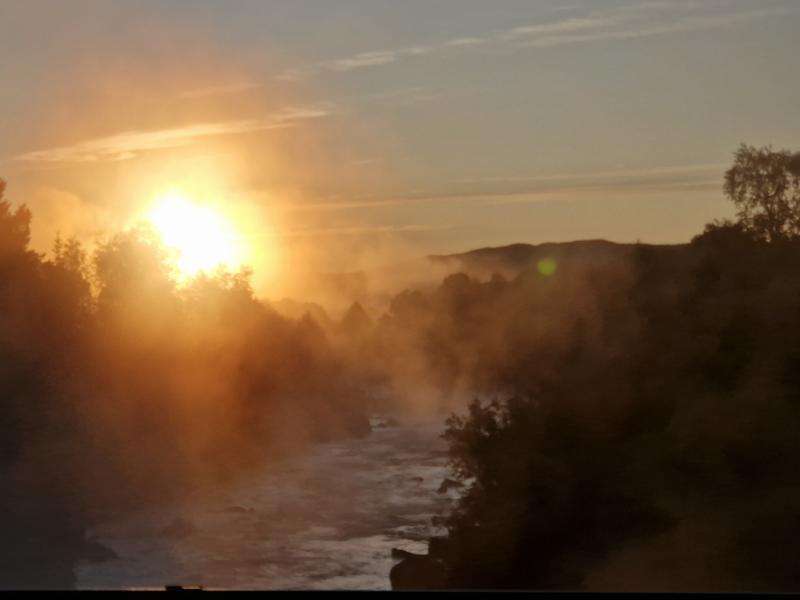
The route continues to roll up and down. I enjoy it, and my legs seem to appreciate the variety. Every climb is rewarded with another fast descent.
Then, in a small village, I pass a Joker supermarket. I had marked this one in my planning as a 24-hour shop. And there’s nothing else around for miles. And there it is! I almost cheer. Unfortunately, it’s unmanned. Which means I somehow have to get inside. A kind woman helps me out, opening the door for me before driving away again. I just hope I’ll manage to pay and actually get back out of the shop. Karin hadn’t managed that on the first night.
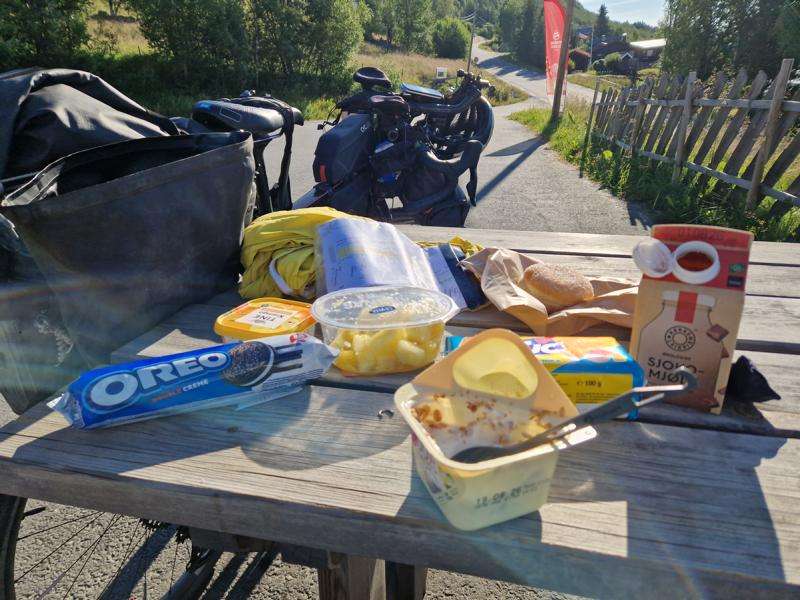
First I look around and proceed to buy half the shop. Everything works, and there’s even a nice little picnic area in the sunshine outside. But I have to admit: I become a shoplifter here. I put a piece of cinnamon bun in my basket. Naturally, it has no barcode, and with the self-service checkout being in Norwegian, I simply can’t figure out how to add it to my purchase. I feel a little guilty. But by now I can’t exactly put it back … Once you’ve picked something up, you might as well eat it. And besides, I need the calories.

Back on the road. I’m already running a little behind schedule.
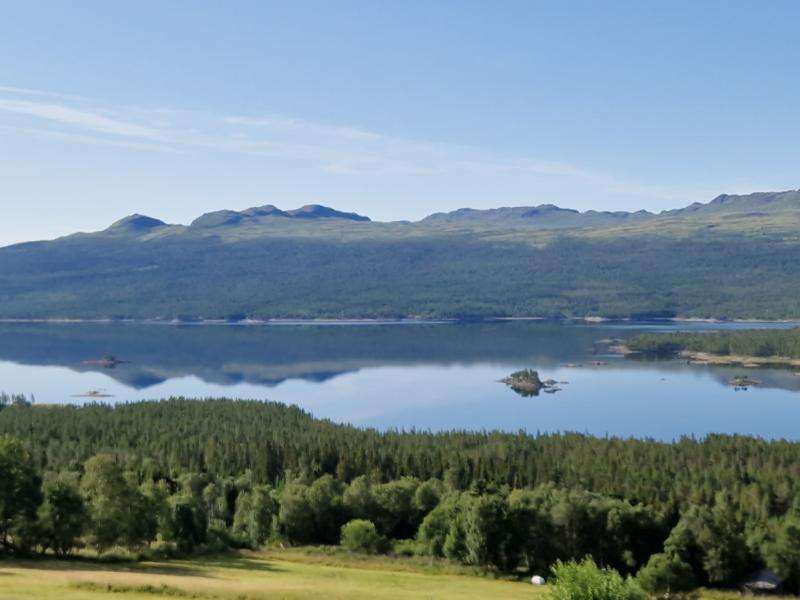
Then it’s forest, forest and more forest. Just as you imagine Norway to be.
Eventually I descend from the plateau. It gets warm. Then very warm. I get sleepy and start yawning. Even though I managed to sleep for six hours for once, I need a power nap. I give myself 20 minutes. And of course, it’s a slippery slope: before long I’m taking another break. But it’s simply too tempting to stop at the petrol station in Lampeland for a coffee and an ice cream. I’m always amazed at how quickly time disappears during these little breaks.
I’ve now covered 150 kilometres and still have another 110 to go before the ferry. The forces of nature have decided to join in as well, sending a cheerful headwind my way. I expect to reach the harbour in Horten around 9 p.m., take the ferry to Moss and then find somewhere to pitch my tent. Somewhere.
In Kongsberg there’s another short, steep climb, and here I meet a few fellow TCR riders again. Otherwise, it has been a pretty lonely day. More forests and lakes. And still 80 kilometres to go … This is taking forever today!
Eventually I reach the sea, and the ferry is not far away. A supermarket along the way comes at just the right moment. I stock up! In fact, I can barely squeeze all the delicious supplies into my bags. But I also have to think about the next day: according to my plan, there’s nowhere I can count on getting food until well beyond the border crossing into Sweden. I’ll probably be too early for Frederikstad and Begby. I’m hoping for the McDonald’s just across the Swedish border.
At the harbour, I manage to do one more unnecessary lap because I follow the signs meant for cars. When I finally realise my mistake, I can just about roll straight onto the ferry, which is already preparing to leave. But wait! I don’t even have a ticket! Oh, come on, stress, give me a break! Then I find out that cyclists and pedestrians travel for free. Well, there you go.
On the ferry, I fortify myself with the dinner I brought along. Wipe my mouth and – just like that – we’re there.
As I roll off the ferry, I spot a dark-skinned man watering a garden. I ask him if he would mind hosing down my bike, which is still covered in dust from the Rallarvegen. He’s happy to help. This will be the very last time I worry about having a dirty bike.
I have to keep going. There are a few riders around me, but before long my route turns right into the forest – as it so often does. The main group follows something resembling an ideal line, while Gabi is somewhere far off to the side. Only after the race will I discover that I did in fact take a small detour. But at least it’s quiet. And I get to experience something the riders on the main road don’t:
I pass fields of grain already lying in the dusk when I spot a dark shape among them. What on earth is that? Surely it can’t be … I’m so excited that I can barely get my phone camera working. An elk cow! She eyes me suspiciously. I don’t dare stop, and the video ends up a little shaky.
It gets darker and darker. By now I can clearly notice the difference compared with the nights I experienced more than 1,000 kilometres further north. I call Hermann. It’s so nice to hear a familiar voice again – and, in fact, to hear any voice at all.
Then, sometime later, after a “mountain” of a whopping 50 metres of elevation gain, I really don’t feel like cycling anymore. Probably quite normal after almost 320 kilometres today.
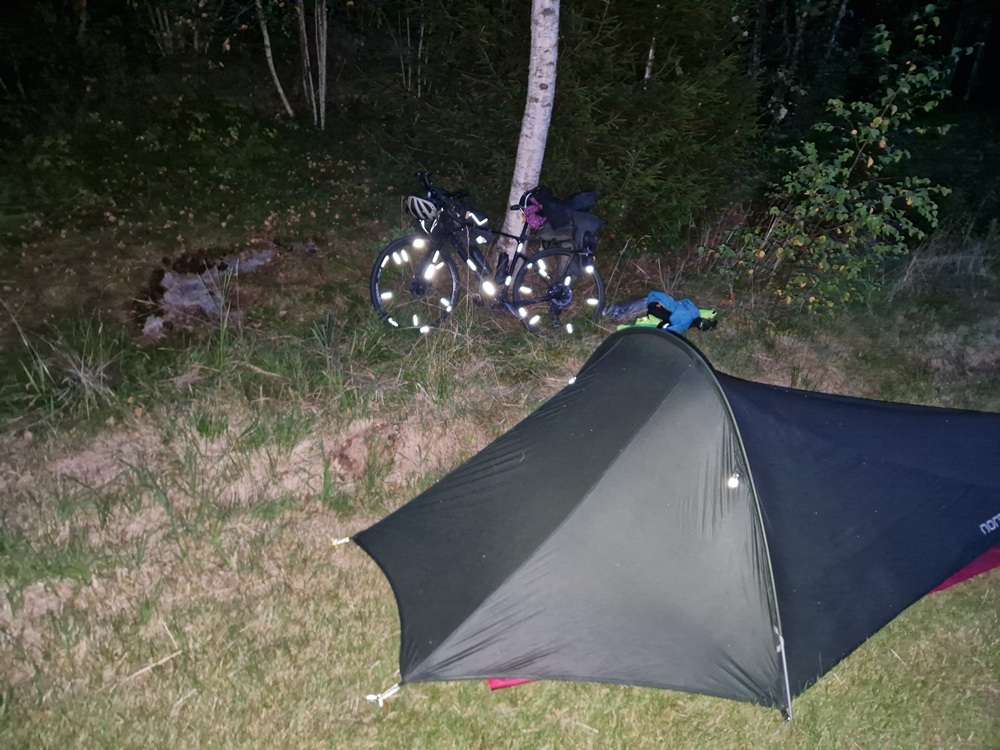
Ahead of me is an irresistibly smooth patch of grass, with no house anywhere in sight. A sign tells me that I’m entering the grounds of the Huseby and Hankø Golf Club. And that’s exactly what I do. I sneak along the edge of the neatly manicured grass, lights switched off so nobody can see me.
Quickly put up the tent, brush my teeth, do a little personal hygiene. Pack everything neatly so I can get going quickly in the morning. Crawl into the tent, check tomorrow’s route one last time, set the alarm for four hours – and sink like a stone into a deep sleep.
Fri, 24 July – Day 5
Packing still takes far too long. I nibble on whatever food I can find and wash it down with canned cappuccino. Three quarters of an hour later, everything is finally packed away and I’m ready to go. My last ritual is still the same: check three times that none of the straps are hanging down where they could get caught in the spokes.

On the road, I realise I’m carrying far too much water and pour out a bottle. Later, I’ll discover that this wasn’t such a brilliant idea, because there won’t be any chance to refill for quite a while. I also dutifully carry my rubbish with me. Usually past countless rubbish bins, until at some point I remember to get rid of something. Is this what you’d call “rubbish tourism”? By now, I entertain myself with thoughts like that. And with calculations. I spend the whole day doing sums. Sometimes it takes me about two hours to work out a simple addition. I’m running a little behind schedule, but not by much.
It’s beautiful riding through the early morning. Maybe I’ll see another elk out here in the middle of nowhere? And why isn’t anyone else riding this way? I’ll only discover the rather substantial extra loop later, when I look at the map.
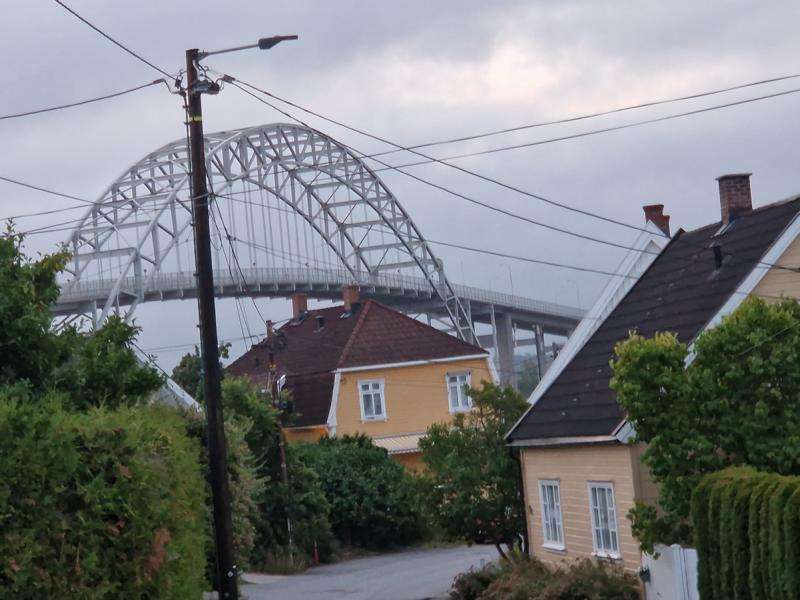
I ride through still-sleeping Fredrikstad and then cross the “Brua”, the bridge over the Glomma. More meadows, forests and fields. I’m approaching the strait between Norway and Sweden, connecting the Skagerrak with the Iddefjord. As I climb towards the historic bridge, opened in 1946 and reserved for pedestrians and cyclists, my gears suddenly stop working. The initial shock quickly turns into the realisation that the battery in my SRAM is dead. Fortunately, I have a spare battery and the charger with me. The swap is done quickly and the empty battery goes straight onto the charger. Hopefully, I’m now prepared for the next 1,000 kilometres.

A hundred metres of climbing done. My legs are definitely feeling a little tired. After all, this is already my sixth day on the road. Another thing is beginning to bother me, though: I haven’t washed anything yet. And everything is slowly becoming a little … sticky. I honestly wouldn’t have known how to organise the laundry anyway. It has always been cold. Even in the hotel, my clothes wouldn’t have dried during the four-hour break I had there. I’m hoping it will finally get warmer from here on. Wash, hang everything on the back of the bike to dry … but where am I supposed to wash it? The next night will be somewhere outdoors again, and the one after that on the ferry … Hopefully!
On the bridge, the obligatory photo stop: a view across the fjord towards the new four-lane prestressed-concrete bridge, which has even won the Norwegian Architecture Award.
From here I roll down towards the large shopping centre. It’s a popular destination for Norwegian shopping tourists. They apparently get up considerably later than I do, though. I had been looking forward to breakfast and an extensive shopping trip – at least when it came to food – and find everything closed. Even McDonald’s isn’t open yet. So I sit there all alone outside the fast-food temple and eat the last of my supplies for breakfast: a few cocktail tomatoes, a slightly squashed wholemeal roll, a packet of sliced Cheddar and half a litre of Kirsebær Yoghurt – cherry yoghurt. I’d already had the can of cappuccino with my first breakfast.
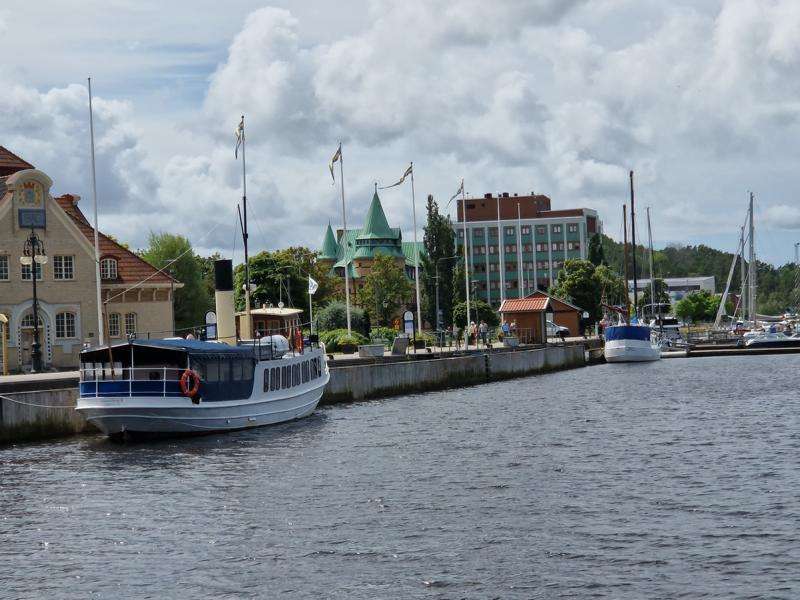
Fed and refuelled, I continue. I’m not exactly bursting with motivation, though. I start calculating again. Almost 300 kilometres still lie ahead before the end of today’s planned stage, and I’ve already done 45 this morning. According to my excellent mathematical skills, that makes almost 350 kilometres today. And another 250 tomorrow to the ferry. Is that even doable? Those huge numbers weigh rather heavily on my mind. The ferry leaves just before midnight, and I need to be in Ystad two hours beforehand. I haven’t even bought a ticket yet because I have no idea whether I’ll make it there on time. Fortunately, the route is almost flat. Only – and here comes the irony – 2,700 metres of climbing today and around 1,300 tomorrow.
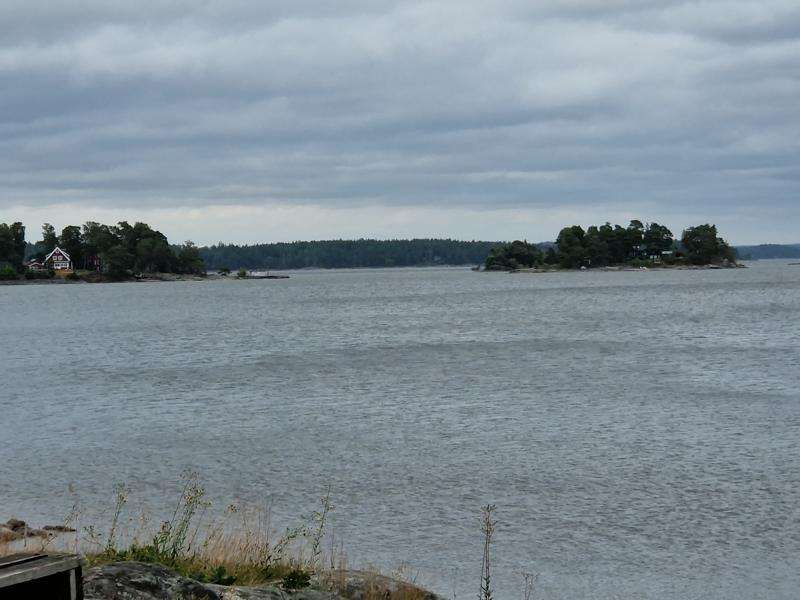
I had been looking forward to Sweden, but here comes another disappointment. My road runs parallel to the motorway, and there’s plenty of traffic. It’s all rather monotonous, slightly uphill, slightly downhill, but most of the time I have the feeling I’m riding uphill. My legs really aren’t fresh anymore. Another blow to my motivation: Hermann has just told me that apparently nobody normally rides the route I took from Moss to the Svinesund Bridge. So that really was a detour. Oh well – what’s done is done. There’s no point worrying about it now. At least it was traffic-free. Still, I can’t help questioning my route planning a little. If these “detours” keep adding up, I’m never going to make it to Kalamata. With a more direct route, I could at least sleep a little longer … Right now I’m questioning everything: the poor road surface, the headwind, the unkempt landscape and the houses.
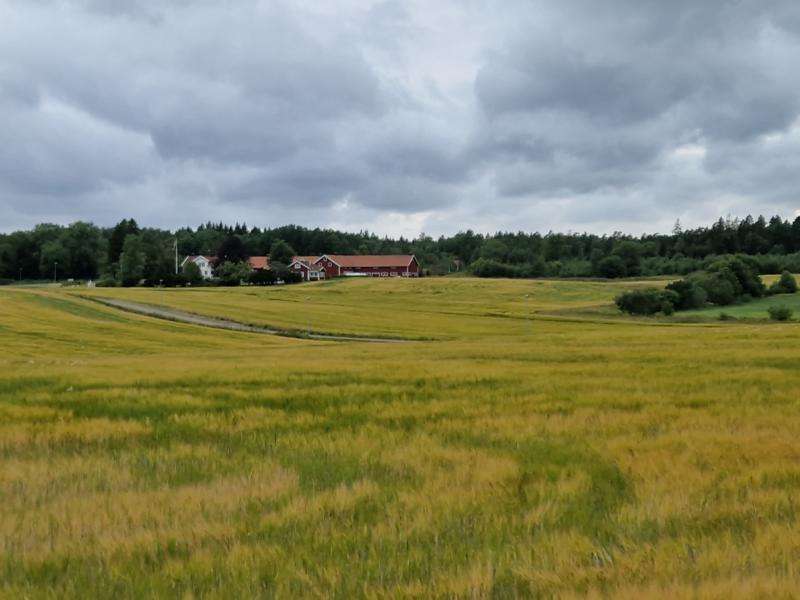
Fifty kilometres later: coffee stop in Tanumshede. Cinnamon bun – obligatory in Sweden –, another pastry, a bread roll to take with me and a very good latte.
My spirits come back to life. Motivation is rising again. The question is: for how long? One of my fellow riders, Matthew, is sitting at the table with me. Unfortunately, he has to pull out. His Achilles tendon is causing serious problems and he can barely put any weight on his foot. “My head is still good,” he says, “but my body doesn’t want to go on.” After more than 1,300 kilometres. I wonder how anyone can be crazy enough to choose something like this as their first ultra … And me? Apart from the pitch-black thoughts, I’m doing fine.
On the road, I keep slipping back into calculations. If I don’t make it to the ferry by midnight tomorrow, I’ll have to take the next one the following day. That would throw my entire schedule into chaos. And the schedule is already pretty tight.
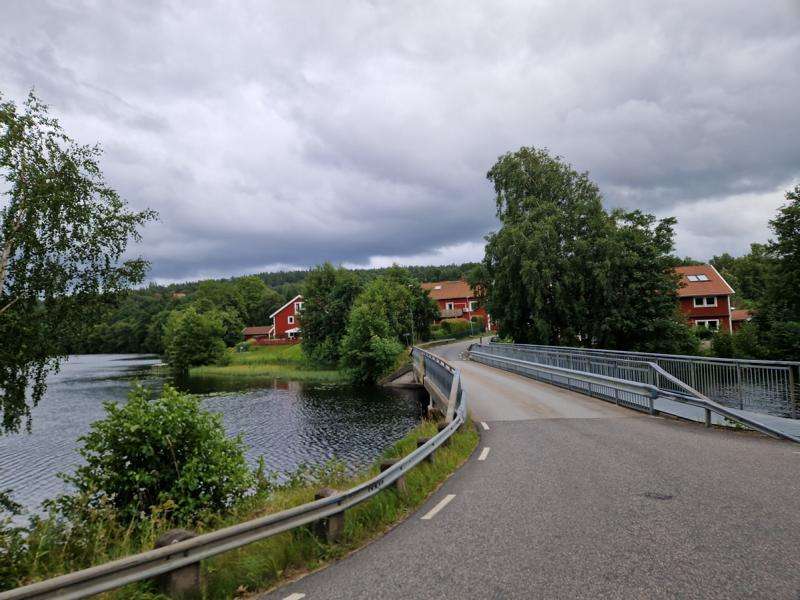
The wind turbines are spinning fast. The sky is rather gloomy and big, puffy clouds hang low. Rain is about the only thing missing now.
Once again, I’m riding alongside the motorway. The air actually isn’t too bad here. Then again, almost everyone seems to be driving electric cars.
I’m not paying enough attention and a small navigation error takes me along a field track before I finally get back onto the route. No point riding a single unnecessary metre – so turning around isn’t an option.
On the map, my route looks pretty straight. In reality, today is one long zigzag: sometimes on one side of the motorway, then on the other. Through villages, then forests and fields again. Looking back, I’ll barely remember anything particularly distinctive. Except for one stretch south of Uddevalla. Countless vintage cars overtake me or come towards me. A little research later reveals that this exact weekend is the annual “A-Bombers Old Style” classic car meeting at a campsite along my route. American classics from before 1956, in every colour and width imaginable, are being paraded along my road – much to my delight. Well, not quite.
The wind can’t seem to make up its mind either. Sometimes it comes from the side, sometimes it pushes me along strongly – but unfortunately, most of the time, it’s pushing from the front.
Sweden has an endless number of lakes. My route takes me from one to the next. Some are packed with tourists, while others lie completely secluded in the forest.
Eventually, there isn’t much of the day left. Looking back, this wasn’t exactly my finest day in terms of motivation. Probably partly because I’ve been constantly worrying about whether all those kilometres to the ferry are actually achievable.
Now it starts to rain, just a few drops at first. I call Hermann and our daughter Katrin, and they manage to lift my spirits and somehow “push” me over the next few hills. Nothing high – perhaps 80 to 100 metres of climbing at most – but usually quite steep.
I still have no idea where I’m going to sleep. The little village of Älsvered, the end of my planned stage, is still 20 kilometres away. But fatigue is beginning to take its toll. It’s almost 11 p.m. In a small village called Torestorp, I spot a suitable little park between the houses, which are fairly spread out here. I put up my tent under a tree. No sooner have I completed the usual routine and disappeared into the tent than it starts to rain lightly.
I drift off.
SAT, 25.07. – Day 6
Very early, at half past three, the alarm goes off. Five hours of rest have to be enough today – including putting up and taking down the tent. I shake the tent out as best I can, but it is still soaking wet and has to go straight back into my bags. Extra weight I’ll have to carry around all day. The route is almost flat, though, so at least there’s that.
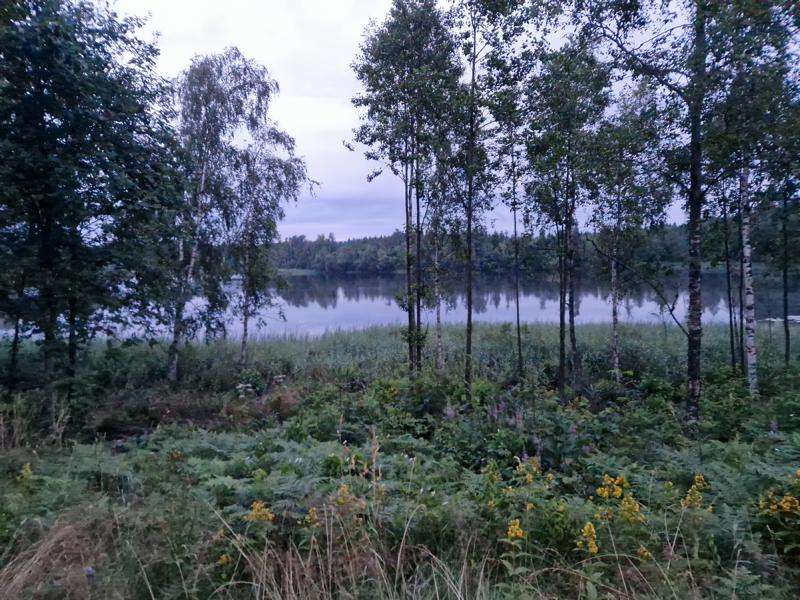
The ride is beautiful: deep forests, clearings and lakes. There are even ten kilometres of gravel. But just 20 kilometres later, another wave of sleepiness hits me. I head for a bus shelter. First I have to clear a few crates of books off the bench – apparently it doubles as a public library. Then I make myself comfortable, set the alarm for ten minutes and … of course I can’t fall asleep. So I set off again before the ten minutes are even up. Somehow, I just can’t seem to get going today.
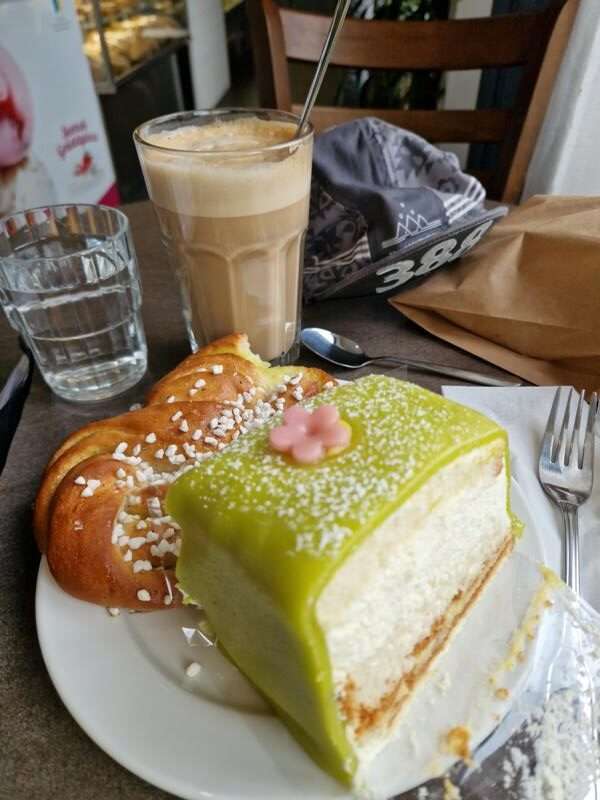
Shortly afterwards, another stop: a quick toilet break, accompanied by a handful of blueberries. A phone call with Hermann doesn’t bring the usual boost of motivation either. Quite the opposite. He tells me that, with the route I have chosen through the interior, I seem to be pretty much on my own. Everyone else is following the coast. Great! Motivation: minus five.
The route is deserted, winding through the forest. Deer, rabbits – otherwise not a living soul this early in the morning.
After an unexpected breakfast of two enormous pastries and two large milky coffees, things suddenly start going really well. For about 60 kilometres, I make excellent progress. Then comes pizza – and somehow that seems to help again. Apparently, by now my body is quite easily pleased.

Another 100 kilometres to Ystad. I’ve already covered 150 today. My thoughts become a little more positive when I realise that I’m actually moving along quite nicely. The ferry is booked, although there are no cabins left.
I had been looking forward to eight hours of sleep in a proper bed, but apparently I waited too long. Washing my clothes will have to wait until Poland. Considering that I’ve been wearing the same cycling clothes for a week now, it’s actually not too bad. The cold weather has kept the sweating to a minimum. A quick wash with my pink cycling cloth seems to have done the job.
Today I make another petrol station stop for cinnamon buns, coffee and Coke. And then I suddenly remember there’s something else I need to do: the wind is blowing nicely, so I hang my tent up to dry. Finally! At least I can get rid of some of that extra weight.

There isn’t much spectacular to tell about the forest and country-road riding. Looking back, I remember surprisingly little of it. Sometimes a cycle path, sometimes a road, then forest again, followed by wide open fields and deciduous woodland. The landscape simply rolls past me.
Near Hörby, my little side roads come to an end and I have to spend the next 50 kilometres on a busy road. There is a narrow shoulder, separated from the traffic by a raised white line. Riding over it is an unpleasant, constant rattling.
I had been wondering whether my decision to take a route far away from everyone else was really such a good idea. Now I’m actually quite happy with it. Some of the other riders tell me that most of their route through Sweden was on roads exactly like this one. Awful!
My next stop is Sjöbo. I stock up at a large supermarket for the ferry crossing. I can barely squeeze all the food into my bags. I plan to rearrange everything at the ferry terminal once I’m sure I’ve arrived early enough.
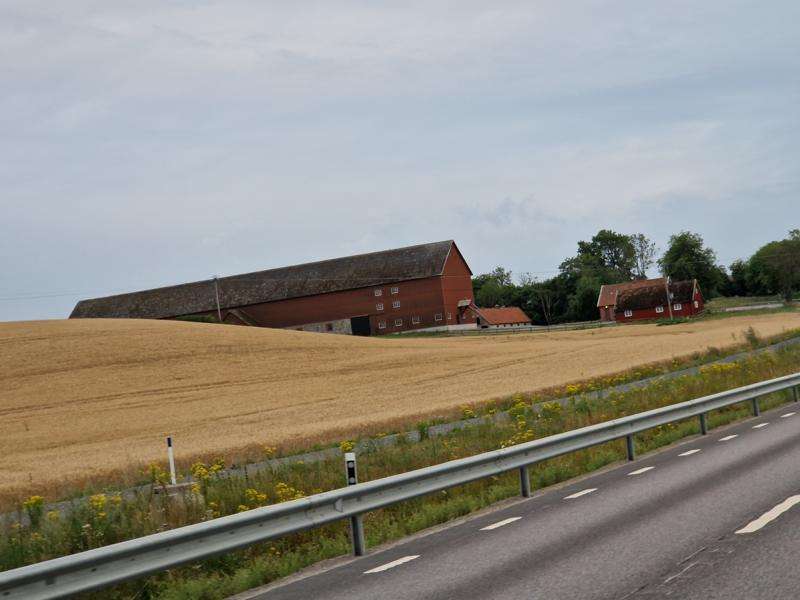
Until then, I thought I had all the time in the world to roll comfortably towards the ferry. Suddenly, with a shock, I realise that I still have 25 kilometres to go – and the clock is ticking. I run into Kiki and Andreas, but they disappear again around the next bend. I simply can’t go any faster. Luckily, there is a cycle path now. I ride through wide fields of grain and probably pass the pretty red wooden houses, so characteristic of the Nordic landscape, for the last time.
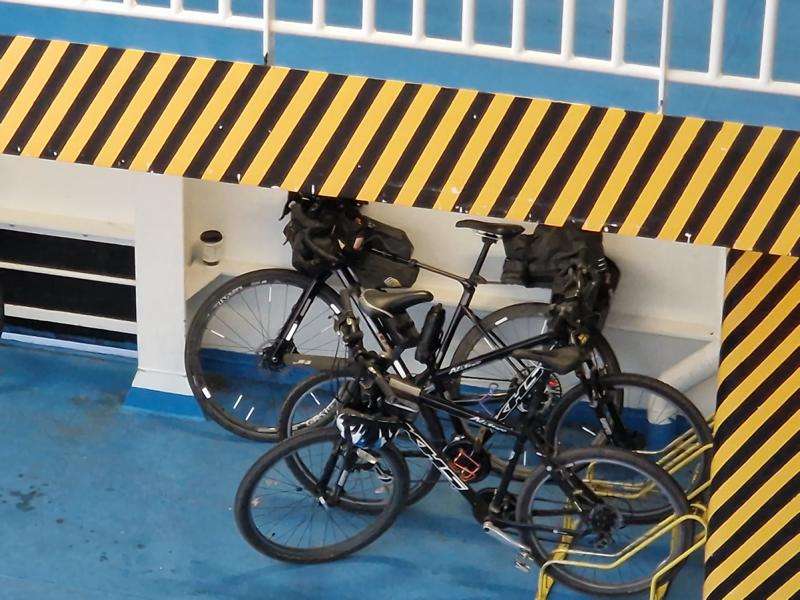
Then I finally reach Ystad. I’m surprised by how large the harbour town is and have to ask around to find my way to the ferry terminal. There I meet quite a few of my fellow riders again, already waiting in line. It’s getting dark. I don’t have much time to sort out my sleeping gear, so I quickly gather my tent groundsheet, sleeping bag and some food – and suddenly we’re allowed onto the ferry.
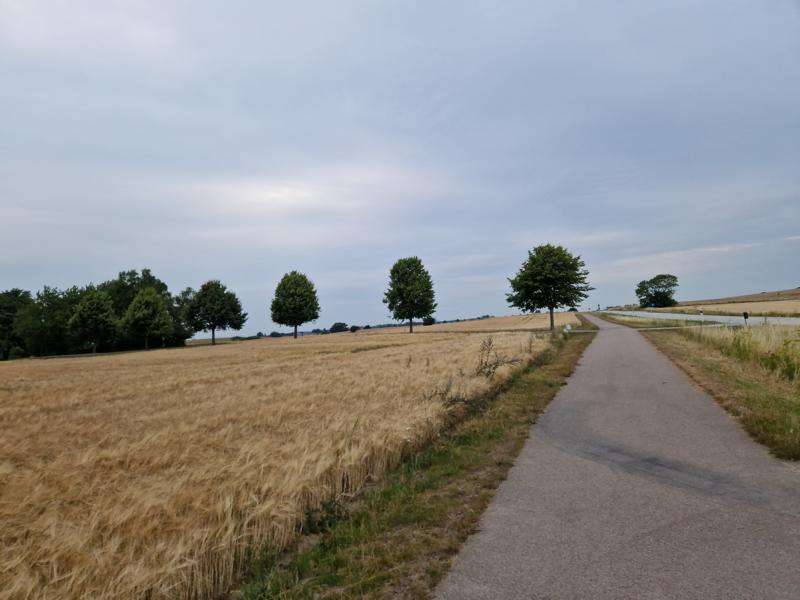
Apparently, my time planning wasn’t quite as generous as I had thought.
At least I’m relieved to be among the first onto the ship. As it turns out, I’ve been carrying my sleeping bag for nothing: Kiki and Andreas manage to get a cabin at reception before me. And, incredibly, there is still one left. It’s only for two people, though, and there are no women-only cabins left. On the spur of the moment, I decide to share it with Filip. Sleeping place secured!
After eating an entire glass of pickled herring, I finally get to take a shower. A long, wonderfully hot shower. Then I disappear into a deep sleep.
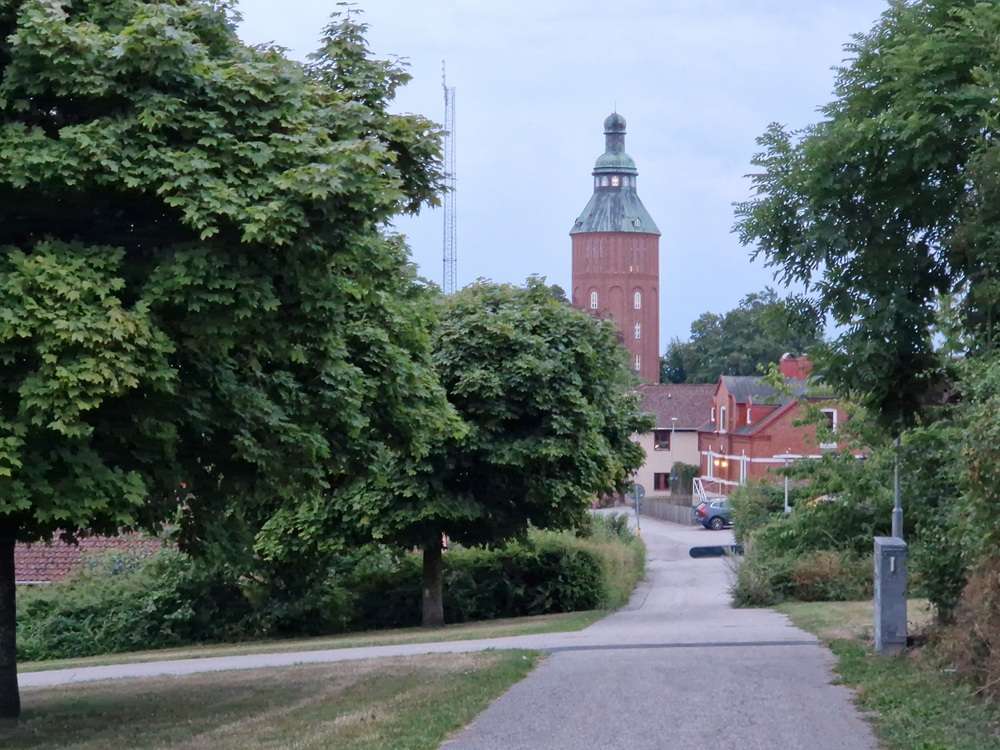
In the morning, I head straight for the generous breakfast buffet. I pile my plate high, then go back for more – who knows when I’ll get another proper meal? Fruit, salad, yoghurt, cheese, muesli, bread, all mixed together, washed down with several cappuccinos. When the breakfast room slowly starts to empty, I realise with a shock that we’ll soon be docking in Świnoujście.
There’s just enough time for a bit of bike maintenance and to pack everything neatly away – and then the ship spits us out into Poland.
From Świnoujście, I now have around 1,000 kilometres ahead of me, with roughly 9,000 metres of climbing to CP2 in Slovakia. Before I get there, I still have to complete two mandatory parcours, one of them with a substantial gravel section. Today is Sunday, and the cut-off is Thursday at 11 a.m.
It’s getting exciting.
Will I make it?
Back to the ← TCR overview with all stages
Next: Svinemünde to CP2 →


