first my video day 14 to 17:
Rest of Day 14, Sunday, 2 August
65 km | 1,000 m elevation gain | 6 h

With the CP3 stamp safely in my pocket, an enormous weight suddenly lifts from my shoulders. I arrived about ten hours ahead of the cut-off – something I certainly hadn’t expected. For the first time in a long while, I feel as though I can breathe again.
So I decide to take my time and have something to eat. While waiting for my food, I have what seems like a brilliant idea: why not wash my entire cycling wardrobe while I’m here? When am I ever going to have this much time and a washbasin at my disposal? Unfortunately, I hadn’t counted on the restaurant garden being absolutely packed. And the sanitary facilities consist of two tiny toilet cubicles with an even tinier washbasin. Clearly, this place is very popular.

So what now? Should I really dare? I do. Apparently, by this point, I’m no longer embarrassed by anything. I soak my entire cycling wardrobe in the tiny sink. If someone comes in wanting to wash their hands, well, they simply do it over my soaking clothes. What can I say? By now, anything goes. Rinse, wring out – and then hang the freshly washed TCR wardrobe all around my bike to dry. Very decorative.
Meanwhile, my food arrives: vegetable soup with bread, a few grilled chicken breasts, chips and – finally, after days on the road – some salad, cucumbers and tomatoes. After so many days of cycling, just seeing fresh vegetables feels almost like a feast.

Eventually, I have to tear myself away from this pleasant little spot. The clothes are still damp, but I pack everything back onto the bike. Just like a few days earlier at the BP petrol station in the Czech Republic, I’m once again travelling as a mobile clothesline. Most of the clothes go straight back on while still wet – in this heat, it’s actually quite pleasant and provides a little welcome cooling.
My route initially takes me down a very steep, narrow descent towards Pale. After about three kilometres, the asphalt suddenly turns into gravel. And not just any gravel – pretty awful gravel. I remember that during my planning I had two options for the next 15 kilometres or so. Clearly, this one wasn’t exactly my finest piece of route planning.

I check the map and reluctantly decide to turn around. Back at the top, the next surprise is waiting for me: a roadworks sign. Again.
I stop an oncoming car with the roof down and ask the driver whether I can get through. He looks me up and down and says yes, it’s possible. But it’s still quite a long way to Pale, he adds, and it’s already getting late in the afternoon.
“How far?”
“Fifteen kilometres!”
Presumably he sees an ageing woman with a heavily loaded bicycle standing in front of him and has his doubts. I don’t really want to let that go. So I mention that I’m riding a bike race across Europe.
“Aha!”
Apparently, that changes his perspective immediately. Compared with that, fifteen kilometres is obviously not very far for me, he says.
Well then. Problem solved.
I continue, with quite a bit of up and down, but at least the road is pleasantly shaded by the forest. And who knows what that gravel track would actually have been like further down. Perhaps my supposedly bad decision was actually the better one after all.
In Pale, I realise that I should stock up on supplies once more. It’s Sunday and, naturally, nothing is open except a petrol station. Luckily, there is one. I probably wouldn’t find anything in Goražde, the next larger town, by the evening – and possibly not even the following morning in Priboj. That means roughly 150 kilometres without any reliable opportunity to buy food. The next proper supplies will have to wait until Serbia.
So I stock up at the petrol station. Along with the usual canned coffee, cocoa and biscuits, I buy two bottles of water: one still and one sparkling. The sparkling water is a welcome change after the bland, lukewarm soup in my hydration pack. Out here, you learn to appreciate the little things – sometimes a bit of fizz is enough to make you happy.
Whether the sparkling water was actually such a brilliant idea, though, remains to be seen.
After sunset, it becomes a little cooler up in the mountains. The road winds past high rock faces, and according to my route plan, the two-kilometre Štambolić Tunnel is coming up. It’s forbidden for cyclists, but fortunately there is an old railway tunnel running parallel to it that we can use instead.
Only I turn off too early, of course, and find myself climbing a steep gravel track. You have to treat yourself occasionally. When I realise my mistake, I turn around and bump my way back down the pothole-ridden track.
Suddenly: Pop!
Something cold runs down my back.
No, not metaphorically. Literally.
“What the hell…?”
Then it dawns on me: the sparkling water in my hydration pack!
Apparently, the carbon dioxide wasn’t particularly happy about being bounced around on the rough descent. The resulting cold shower isn’t exactly pleasant – especially since I now have to head straight into the dark, chilly tunnel.
The road continues gently downhill through the Prača Valley. I lounge comfortably on my triathlon aero bars. I pass through several small villages with mosques, their minarets visible from a distance.
Something catches my attention. It’s already getting dark, and every now and then I notice curious male looks from cars coming towards me or overtaking me. Some of them shout something at me.
What’s going on? I look down at myself. A woman travelling alone – and then wearing tight-fitting cycling clothes, short shorts and bare knees. I discreetly tug at the bottom of my shorts. It doesn’t really change much.
As it is getting cooler, I stop briefly and pull on my knee warmers. They have been in a rather worrying state of decomposition for some time now: threads hanging everywhere, ladders running through the fabric. I should really have thrown them away ages ago. During the heatwave of the past few days, I hadn’t needed them anyway.
Now they serve at least one important purpose: they cover my knees. And suddenly I feel a little better. Not necessarily more elegant – but at least slightly less exposed.
After about 50 kilometres, the next climb begins. Around 500 metres of elevation gain take me winding upwards, and the climb feels hard. I haven’t actually ridden that many kilometres today, but I’ve already tackled several tough climbs. So I suffer my way upwards for a while. After that, there is one final little climb, and then I’m supposed to have around 20 kilometres of descent to Goražde.
By now it is dark. During planning, however, I hadn’t realised that part of the descent would be very steep and on gravel. I can’t find the turn-off – presumably it is nothing more than a narrow hiking trail. So I check the map and decide simply to follow the asphalt road.
Only the road continues uphill first. Then downhill, then uphill again. It is incredibly twisty, and before long I have completely lost my sense of direction. To make things even better, my Garmin freezes.
Wonderful.
So I simply follow the road, without really knowing where I will end up. Every now and then I stop to check my position on my phone. Eventually, it actually looks as though I’m still heading in the right direction.
It is almost 11 p.m. and I am absolutely exhausted. I’ve been on the road since four in the morning and all I want now is sleep. According to my original plan, I should have ridden another 100 kilometres and then reached a hotel bed. But somehow the worm has been in the plan since yesterday, and my progress has kept slipping further and further behind.
Enough already. I need a break from this stress.
Until now, I had always reached the checkpoints on time. But would that still be true at the next one, CP4 in Albania? I’ve already ridden 3,700 kilometres. And the question is becoming increasingly urgent: will my lucky streak of arriving on time finally come to an end?
Just before Goražde, I spot a mown patch of grass above the road, with a little hut and a few benches. I inspect the place and decide it will do for tonight. In a small hollow between the trees and benches, I find a reasonably sheltered spot for my tent.
As soon as I disappear into my little four-walled home, a car stops down on the road. A few men talk among themselves. Then they drive away.
Phew.
I’m just drifting off when it starts.
Dogs barking.
First one. Then several.
Soon it sounds as if the barking is coming from all directions, in every possible pitch and tone. Apparently, my canine orchestra has decided to take over the night shift as well. High, low, short, long. It sounds almost like a recording someone has put on an endless loop.
I start wondering whether perhaps someone really has recorded dogs barking to keep other dogs – or unwanted visitors – away.
Quite an unusual goodnight concert.
Day 15 – Monday, 3 August
230 km | 3,500 m elevation gain | 13 h

I push my bike down to the road. And suddenly it becomes clear: the dog orchestra really was live. A whole pack comes charging towards me, barking and growling. They don’t exactly look as if they have good intentions. Before I know it, they have surrounded me. I get off the bike, face the boldest one directly and shout as loudly as I can: “Go away!” Apparently, I’m more convincing than I feel at that moment. The dogs actually back off.
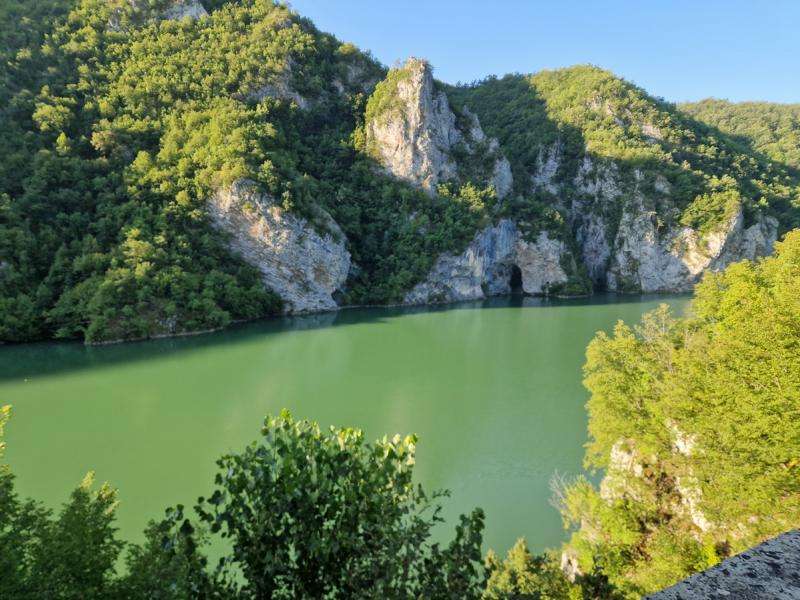
I must have made quite an impression, because the whole pack disappears into the bushes below the road. I ride on. Around the next bend, there are two more dogs standing in the road. Whether they belong to the same group, I have no idea. This time they remain calm, and I pass without any trouble. Perhaps word has already got around that the woman on the bike is not to be messed with.
My mind starts racing. I had actually wanted to leave early, but unfortunately that didn’t happen. My alarm didn’t go off – the watch was completely dead. I’m frustrated and a little demotivated. Somehow, it feels as though everything is already too late anyway. Hermann had calculated how many kilometres and how much elevation I would have to cover to reach CP4 on time. And now there’s another thing making me doubt whether I can manage it. It’s already daylight, I should have covered plenty of kilometres by now, and instead I’m only getting started after five.

Still, the late start has one advantage: in Goražde, a bakery is already open. So I stop, get something to eat and even manage a quick wash. Right afterwards, I get a coffee at the petrol station. After the night in the tent, this feels almost luxurious.
Of course, I’m well aware that this isn’t exactly the way to get a fast start to the day. First oversleeping, then two stops so early in the morning – a spectacular comeback is definitely not happening yet. And I still have a long way to go today. There won’t be much opportunity to buy anything for quite a while. The next supplies will have to wait until Serbia. So now it’s time to stock up and finally start putting some kilometres behind me.

I hope it won’t get unbearably hot again today. Traffic is already quite heavy this early in the morning. According to the tracker app, several riders passed me during the night. By now, I’m probably among the very last ones. And everyone still around me has to hurry if they want to reach Leskovik by Wednesday evening.
I start calculating again. The result is almost impossible to comprehend: it’s Monday, and between here and the next checkpoint there are still about 825 kilometres and 10,600 metres of climbing. 825 kilometres. 10,600 metres of elevation gain. By Wednesday evening. I look at the numbers and seriously wonder how on earth this is supposed to work.
Yesterday I met several riders who had already abandoned the race or planned to ride only a little further. That inevitably affects my motivation too. At the same time, I make peace with myself: I will ride as much as I can. And if I don’t make it, I’ll simply arrive at the finish a day later. There isn’t much else I can do.
And yet the landscape is absolutely beautiful. The road follows the Drina, with spectacular views down into the gorge, and later continues through the Lim Valley. There are countless tunnels along the way. They are allowed for cyclists, although I ride through them with the necessary caution. After the quiet roads of the previous days, there is noticeably more traffic now.

Eventually I reach the Serbian border. The formalities are quick: passport stamped, and off I go. At the first petrol station, I go through the usual routine: food, washing, sunscreen. Petrol stations here in Serbia are often called “Carwash”, and the men seem to have a particularly loving relationship with their cars. They foam them, scrub them and polish them with great dedication. I wonder whether they are equally kind to their wives. The cars – usually rather large ones – are certainly treated with great care. And once they’re clean, they are driven around to demonstrate how quickly they can accelerate from zero to 200.

Despite all the trouble with the dogs, I sometimes have to swallow hard. As aggressive as they can appear, I often feel sorry for them. I repeatedly see dogs limping across the road, some walking on three legs, others completely emaciated. Almost all of them seem to be scratching themselves constantly and look as though they are covered in fleas. At moments like these, it is hard to feel only fear or annoyance. There is so much suffering among these animals, and nobody seems to care.

And then I see it ahead of me: the mountain of doom. Although, of course, I don’t know that yet.
At Bistrica I have to leave the beautiful panoramic road along the Lim and turn left. Ahead of me are 30 kilometres of climbing and around 1,200 metres of elevation gain. The first 15 kilometres to Nova Varoš turn out to be some of the toughest of the entire ride. The mountain itself wouldn’t actually be that bad – if it weren’t for the traffic. The road is far too narrow for what is happening on it. Traffic is heavy in both directions, and huge trucks repeatedly thunder past me. There is simply no room for three vehicles side by side – and unfortunately, I am the third one.
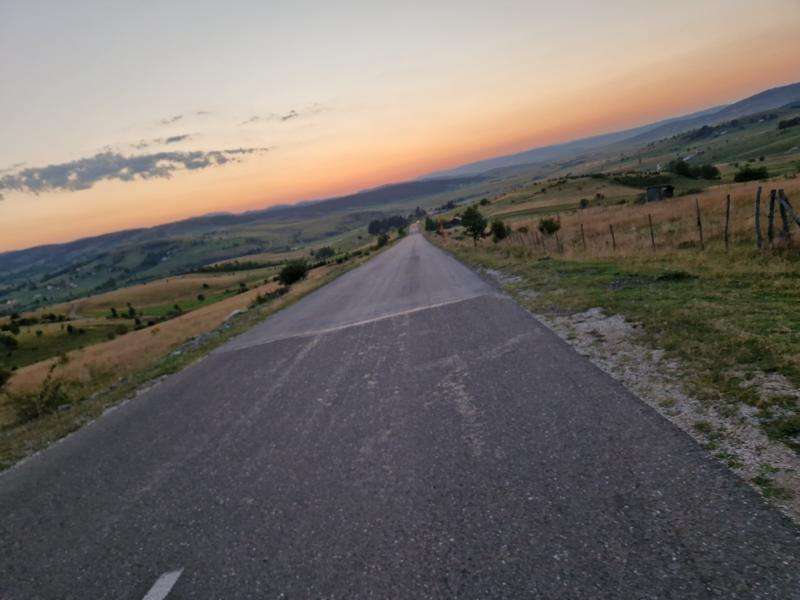
Again and again, I jump off the bike and press myself as close as possible to the edge of the road while trucks roar past. Naturally, progress is painfully slow. Add the steep gradient and the heat, and every metre of elevation feels harder than the one before. The mountain itself would be manageable. But the traffic turns it into my personal mountain of doom.
In Nova Varoš, I make a supermarket stop. Mozzarella with water, tomatoes and kefir – that’s all I need right now. After that, I can finally turn onto a much quieter road. It continues uphill, but simply being away from the traffic makes such a difference that I can enjoy the scenery again. Eventually I reach the highest point, and from there the road continues with rolling ups and downs.

In Sjenica, I then become – albeit unintentionally – something between a shoplifter and a thief. I need supplies and spot plums, grapes and little tomatoes that practically seem to be calling my name. I put them all in a bag and head to the checkout. Unfortunately, the shop only accepts cash. And naturally, I don’t have any Serbian currency.
So I leave the shop and put the fruit back. I do, however, keep two plums and discreetly slip them into my pocket. If I’m going to become a thief, I at least hope they taste good. I’m not entirely comfortable with the whole thing, though.
There are now two more mountains ahead of me, each with around 400 metres of climbing. On the first one, the road becomes so steep that I have to push. A 14% gradient with all my luggage is simply a little too much. On the second one, I take a chain-oiling break. My chain – and probably I too – need a little attention.
Then comes the descent to Tutin. I make another stop at a petrol station. The selection is limited: the only thing that looks remotely suitable is a packet of ridiculously sweet, cream-filled biscuits. They are soft and sticky, which makes them completely unsuitable for carrying on the bike. So there’s only one sensible solution: eat the whole packet immediately. Problem solved.
The petrol station owner has two sons helping out. The older one is perhaps twelve and speaks a little English. I ask whether he learned it at school. No. He is teaching himself – through video games.
In the small villages, I keep noticing large, rather impressive cars with Luxembourg, Austrian or German number plates. I suspect many of their owners work abroad and spend their holidays back home. It’s quite a striking contrast to the small villages they are driving through.
By the time I reach Tutin, it is dark. I make one more supermarket stop, because my plan for the following day once again offers very few opportunities to buy food. I need to prepare. After all the sweet biscuits earlier, I’m now craving something salty. My choice falls on peanut puffs – not exactly what you would call healthy sports nutrition either, but by this point I have other priorities.
I get chatting to the young cashier. I tell her that I still want to cross into Montenegro and then find somewhere along the road to sleep. She looks at me rather surprised.
“Do you know that this part of Serbia has the highest population of bears in the country?”
My reaction is probably a little too alarmed. She immediately reassures me: the bears live deep in the forest.
Well then. That’s reassuring.
Still, I feel slightly uneasy when I set off again. Shortly afterwards, a drinking-water fountain gives me another reason to stop. I don’t find a place to sleep at first. Several kilometres later, I finally spot a mown meadow with a small wooden shelter on it. The shelter is locked, but slightly further back I notice a lorry trailer.

Perfect. I can hardly imagine a better hiding place for my little tent. I set up beside the trailer, lean my bike against it and use the loading platform as a makeshift shelf. I can even prepare my breakfast for the morning.
Then it’s lights out and eyes closed.
Day 16 – Tuesday, 4 August
210 km | 3,600 m elevation gain

Four hours later, I am back on the road again. Setting off again after such a short break has something to do with the temperature, too. After all, I am camping at around 1,000 metres above sea level, and at night it gets surprisingly cold. My sleeping bag has a comfort rating of 10°C – and the temperature is slightly below that. So, cosy is definitely not the word I would use.
But leaving early has its advantages. Every hour I gain today increases my chances of actually reaching CP4 on time the following day. Maybe all is not lost after all. If things go well, I want to at least cover part of Parcours 4 tonight.

The evening before, I had crossed the border into Montenegro. I don’t have much time to get to know the country, though. My stay in Montenegro lasts just 34 kilometres. Today, I will already be leaving again.
All night long, countless trucks have thundered past my campsite. Now a series of tunnels lies ahead. What would probably be rather unpleasant during the day actually works in my favour in the darkness: my lights are much more visible inside the tunnels, which makes me feel a little safer. I am riding through something resembling a gorge, with the rock walls only faintly visible in the darkness.
Then it is time for my first petrol station stop and an early coffee. The friendly staff also offer me something to eat: some kind of grilled item that I have absolutely no idea how to identify. The name sounds something like “Roschtilj”. Later research reveals that it is Roštilj – flatbread toasted on a meat grill. Finally, something savoury again!
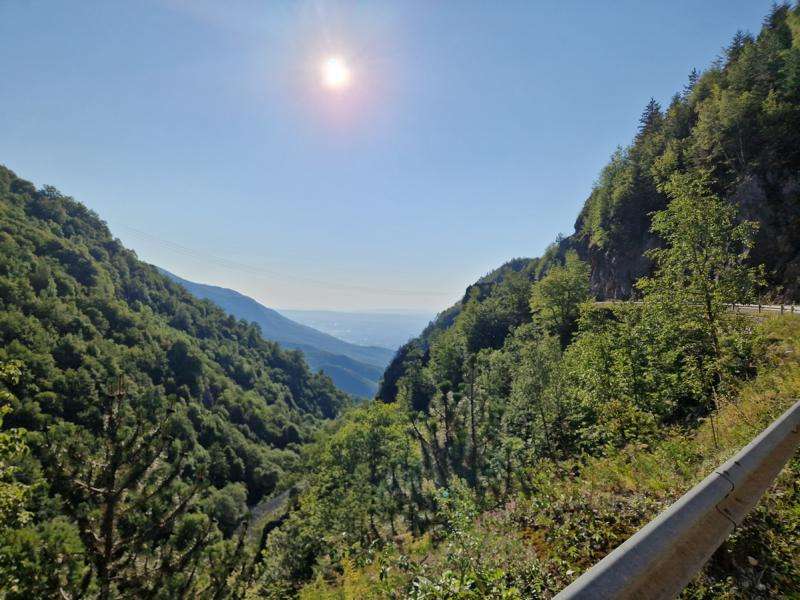
I attack the thing outside the petrol station. For the life of me, I cannot figure out exactly what is hiding inside. It is a little suspicious, to be honest. And since the portion is enormous, I promptly share it with my new friend: a small, black, rather skinny female dog wandering around outside the petrol station.
She is very shy and apparently has puppies. One thing is certain: she is absolutely starving. So there we sit, the two of us outside the petrol station, sharing my mysterious breakfast. I may not know exactly what I am eating, but I know for sure that she is getting some of it. Perhaps this good deed will make up, at least a little, for yesterday’s plum theft.
In Rožaje, the climb towards the border with Kosovo begins, taking me up to the Kula Pass. Around 700 metres of climbing lie ahead. And this is where I start getting properly hot again.
Unfortunately, my route planning is not particularly sympathetic and sends me straight onto an 18% ramp in the middle of town. That is a little too much for me, so I push for a while. On the way, I get talking to a man who is currently home on holiday. He works in Switzerland.
This confirms my suspicion from the previous day: apparently, a surprising number of men from this region work abroad and spend their summer holidays back home. One of the main activities seems to be looking after their big, shiny cars – and then driving them around at considerable speed.
Just before the pass, I get tired again. So I spread my sleeping mat out in the middle of the long grass, lie down in the sun and treat myself to a ten-minute power nap.
Hardly have I got back on the bike when Marius rides past. So, I follow him! The border crossing is quickly dealt with, and then comes a long, beautiful descent towards Peja. The mountain panorama is spectacular.
Peja itself, however, is the exact opposite: noisy, dusty and dirty. After stopping at a supermarket, I desperately need another coffee – and, even more importantly, internet access. Once again, my connection has stopped working.
The bar next door looks like the perfect solution. There is just one small problem: I have no cash. My discussion with the waiter apparently catches the attention of a rather distinguished-looking gentleman, who promptly comes over and insists on buying me a cappuccino.
I tell him what I am doing here, and quite a bit of astonishment spreads around his table.
Only later does it occur to me that, of course, I could easily have paid for the coffee myself. Kosovo uses euros after all.
Oh well. At least I now have a complimentary cappuccino.
Back in the city, I desperately search for somewhere to get some water. It is incredibly hot again, and on top of that, I am stuck in traffic. Then I spot a car wash – my salvation!
The guys there immediately offer me their hose. I promptly use it as a shower, which causes quite a bit of laughter. I couldn’t care less. Wet and cold is all that matters!
Eventually, I manage to escape the noisy, dusty city. The next 50 kilometres or so take me through rural countryside. And I take every opportunity I can find to cool myself down: petrol stations, fountains, garden hoses.
At one point, I even ask a man who is washing his bus whether I can briefly use his hose to cool off. By now, I am willing to try absolutely anything.
The route seems to go back and forth, criss-crossing the countryside all the way to Gjakova. And my internet still isn’t working. It is a pretty helpless feeling when you are travelling in a foreign country and can no longer rely on the connection you normally take for granted.
I certainly feel rather lost.
Now there is another pass ahead of me: Qafa e Morinës, the border crossing from Kosovo into Albania.
On the way, another participant overtakes me. He has a stick attached to his rear bag. A dog deterrent!
Until now, I had never really felt that I needed one. But after the experiences of the last few days, I briefly wonder whether perhaps I should get myself one, too.
On the other hand, I have made it this far without a stick.
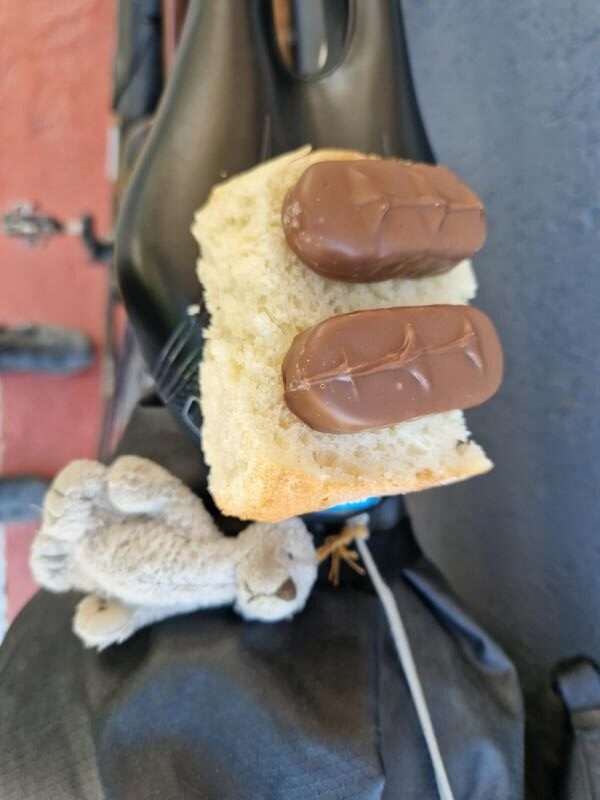
Before the pass, I have one last proper meal: a “Tonno Insalatissima” – greetings from home! Along with some bread, into which I promptly stuff two Bountys.
It may sound a little strange, but it tastes surprisingly good. And in this heat, the only thing that matters now is: drink, drink, drink.
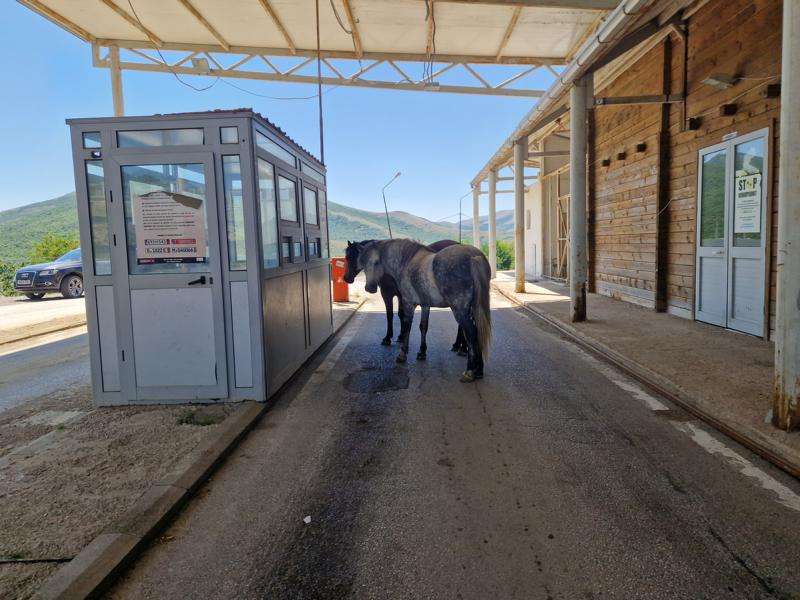
At the top of the pass there isn’t the slightest breeze, and my Garmin is showing 41°C. At the border, I have a brief moment of panic. On the Albanian side, there are just two horses standing around.
Have I missed something? Do I need another stamp that I might later need when leaving the country?
From the border onwards, the kilometres seem to drag on forever. The road is constantly rolling – up and down, only to climb again shortly afterwards. And the heat is relentless.
There is no water anywhere in sight, apart from far below me, where large lakes glitter in the sunlight.
Just before Kukës, I spot a fish restaurant on the bridge over the lake. It would actually be the perfect place for a break and something to eat.
Even more importantly, though, I need Wi-Fi, because I still have no mobile internet.
At first, the waiter tells me that I am welcome to have something to eat. Then it turns out that I can only pay with Mastercard – and, of course, mine isn’t accepted. Cash, meaning euros, would also be fine.
Finally, I ask how long I would have to wait for the food.
The answer: 9 p.m.
I look at him in disbelief. Did I understand that correctly? It is only 4 p.m.!
I begin to suspect that perhaps he simply wants to get rid of me.
So I settle down under a tree in the shade and at least make use of the Wi-Fi. My suspicion is confirmed: apparently, all that surfing while I was in Kosovo has used up my entire data allowance.
Which also means that my Balkan data package no longer works.
Fantastic.
I need to top up my credit first. Hermann is kind enough to do it for me. And then, amazingly, the internet works again.
For the time being…
In Kukës, a lively, bustling city, I am completely wiped out by the heat and all the stress. I still have around 500 metres of climbing and 15 kilometres to go before the start of Parcours 4.
I am simply too exhausted to imagine climbing another mountain right now.
So I decide to get a hotel.
A few hours of sleep, then ride through the night – that is the only way I can imagine covering the remaining distance to CP4.
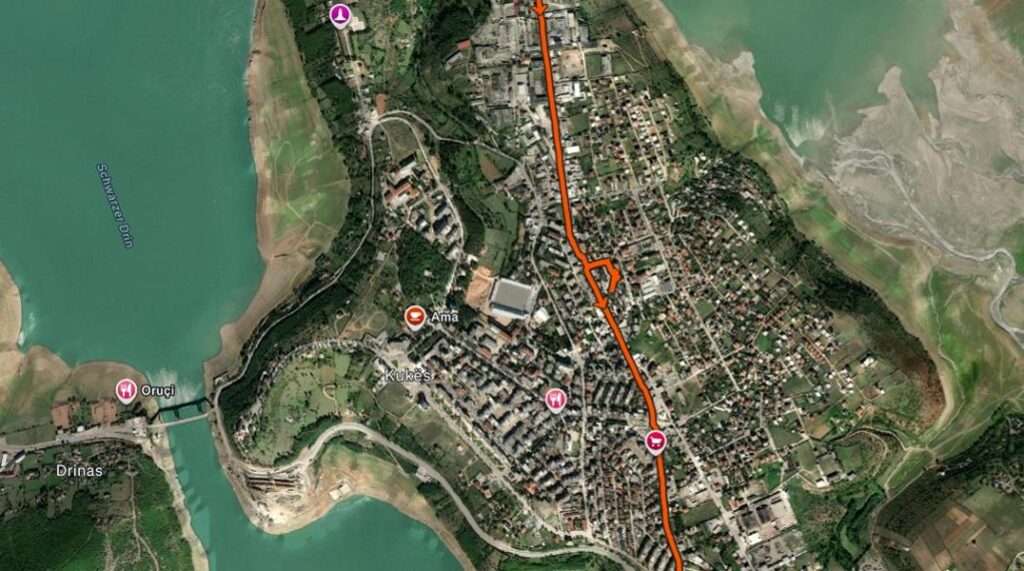
The hotel is surprisingly easy to find: Hotel Dion, a modern four-star hotel – and cheap, too.
Check-in is quick and uncomplicated, and best of all: I am allowed to take my bike up to my room.
I shower, wash my clothes, eat something and sleep for two hours.

More than anything, I would love to just stay there and finally get a proper night’s sleep. But at around 8:30 p.m., the alarm goes off.
It is already getting dark outside when I get back on the bike.
A few dogs are hanging around in the street, barking. But the next encounters are much more unsettling – this time with people, and exclusively men.
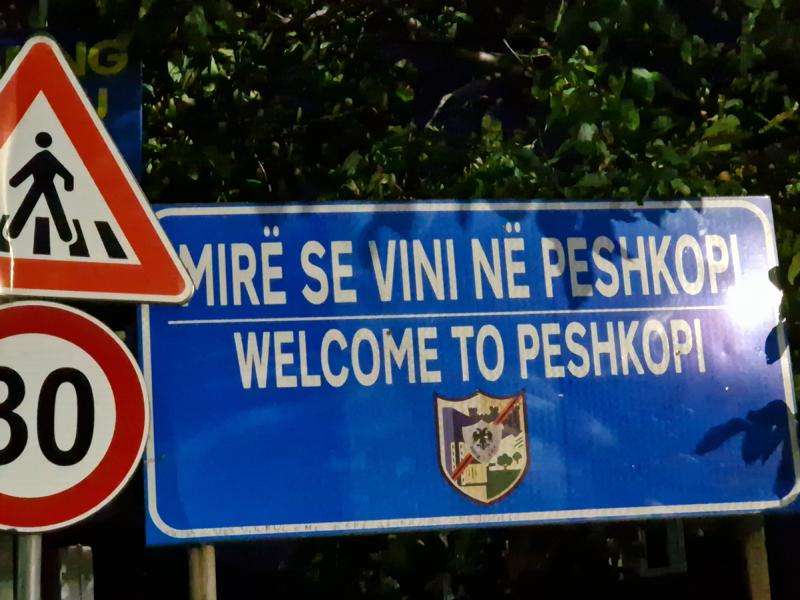
It is now completely dark, and the route leads through rural countryside. In Kolesjan, mandatory Parcours 4 towards Peshkopi begins: 60 kilometres long.
Many men are still out and about in the darkness. People shout things at me from passing cars that I cannot understand.
One clearly shouts: “Danger!”
Shortly afterwards, a van pulls up beside me. The sliding door opens automatically right next to me, and someone asks whether I need a taxi.
Another man gets out of a car next to me and asks where I am from.
I ignore him – just as I have ignored the others before him.
Eventually, it seems that nobody else is out on the road. The road gets steeper and climbs through several villages. Here and there, a bar is still open, with men sitting at the tables and staring at me.
Only occasionally does a car pass.
Further up, a car suddenly appears parked by the side of the road. All the doors are open, but there is no one to be seen anywhere.
I continue riding, feeling slightly uneasy.
Just a few hundred metres further on, three teenage boys suddenly burst out of the bushes. They are shouting and waving their lights at me.
I am absolutely terrified.
“I’m calling the police!” I shout back at them.
By now, I have my smartphone ready in my hand. The SOS app is right there on my home screen. If anyone bothers me again, I can contact the police immediately.
After several brutally steep climbs, I finally reach the highest point after midnight, at around 1,200 metres.
I am exhausted and need sleep.
Behind a bush, I spread out my mat, put on everything I have and lie down with my sleeping mat and sleeping bag.
When two quad bikes pass along the road and turn onto a gravel track opposite me, I briefly cover my light with my hand so they cannot see me.
A little later, they come back down and disappear into the night.
Luckily, they haven’t spotted me.
I had only allowed myself an hour or so for this improvised sleeping place anyway.
And sure enough, it doesn’t take long before I wake up again.
I am absolutely freezing.
Day 17 – Wednesday, 5 August
280 km | 3,500 m elevation gain
I roll into the dawn, heading towards Peshkopi. By now, every village welcomes me with more or less friendly dogs. I have to be particularly alert at the entrances and exits of villages, because that is where the dogs like to hang out.
The ones that come charging towards me barking loudly are usually not even the dangerous ones. Much more dangerous are the quiet candidates that suddenly appear from the side without making a sound. Then there is only one thing to do: get off the bike as quickly as possible and put the bicycle between myself and the attacker. I have just had one such encounter with a filthy white giant. Quite a shock first thing in the morning.
Most of the time, it is enough to ride past them slowly. Eventually, most of them disappear or simply stay where they are. Maybe they mistake me for a car because of my bright front light? Or perhaps they are simply getting fed up with all the cyclists who have been passing through here over the last few days?
In Peshkopi, there are dogs everywhere. I encounter them on every corner, especially around the rubbish dump. I am slowly beginning to realise: in Peshkopi, the dogs are apparently part of the urban population.
Shortly after Peshkopi, the next border is already waiting: North Macedonia. Before that, I stop at a petrol station for a machine coffee. Unfortunately, I don’t have the right coins for the machine. The attendant kindly changes a one-euro note for me. Somehow, I immediately get the feeling that I might have been ripped off. The man then pulls out his calculator and patiently shows me that everything is correct.
Aha. I have apparently just had a little encounter with my own prejudices.
Immediately afterwards, there is a second breakfast in a bar: cappuccino and packaged brioche, plus a little chat with the bar owner. As if I had all the time in the world – or as if I had already given up on reaching CP4. And yet I still have around 200 kilometres to go. Then it’s time for the border.
The border officer disappears and makes way for a woman who thoroughly cleans the tiny booth. Meanwhile, a long queue forms on both sides. Presumably, it is coffee break.
I use the opportunity to put on a generous layer of sunscreen. After more than 20 minutes, an officer finally reappears. First, he has to fetch himself a cushion, then he settles comfortably into his little cabin. The waiting queue doesn’t seem to bother him much. No greeting, no word – as if nobody were there.
Eventually, the border formalities are completed and I continue into North Macedonia.

What awaits me there initially is rather sobering: everything looks run-down, rubbish is scattered everywhere, and there are even animal carcasses lying along the roadside and on the pavements. Not exactly the most inviting first impression of a new country.
From Debar to just before Struga, I ride along a road with moderate traffic through the valley of the Black Drin. The river accompanies me all the way, and in places it spreads so wide across the valley that it almost looks like a lake. After all the hustle and bustle of the past few hours, this quiet stretch is a welcome change. For once, I can simply ride and let the beautiful landscape sink in.
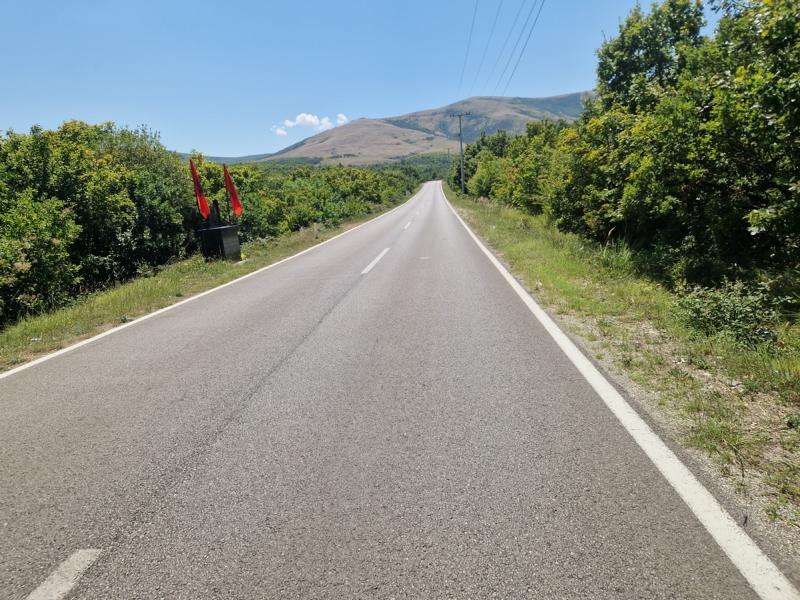
As beautiful as the surrounding landscape is, the condition of the roadside is appalling. Rubbish is everywhere, sometimes in unbelievable quantities. I have never seen anything like it on my travels before. The beautiful landscape and this incredible amount of litter simply do not belong together.
At Lake Ohrid, the picture changes completely. Everything is highly touristy, with people and cars everywhere. And I make the mistake of initially trying to ride along a promenade right beside the lake. I don’t get very far.

By now, I have already written off reaching the CP tonight anyway. I am getting tired when I spot an open gate leading directly to a beach. I ride in, lie down for a short power nap and then cool off in the lake. Afterwards, I get talking to the owner of the property, who kindly points out that it is actually private land. But he says it was an honour to have me stop there. He listens in disbelief as I tell him where I have come from and what on earth I am doing here.
Onwards. By now, I don’t care about much anymore. Three small mountains are still ahead of me, following the lake, with correspondingly heavier traffic. The heat is unbearable again, and there is nowhere in sight where I can cool down. During a short break in the shade, I discover that once again I have no signal.
Could it be that North Macedonia isn’t included in my Balkan package either – just like Montenegro?
I still have the border crossing back into Albania ahead of me. Then I will find out whether I have internet again.
At the border, the female officer seems to have made an agreement with her colleague from this morning. She, too, apparently has all the time in the world – and she is truly quite obnoxious about it. First, she spends several minutes reading something from her smartphone to her colleague while I wait in the blazing sun. Eventually, she turns towards me, examines my passport and gives me a gracious nod.
The barriers in front of me, however, remain closed. I wait for a while and finally ask whether I am allowed through. She looks annoyed and gestures towards the barrier.
Oh. I am supposed to squeeze myself and my bike between the two poles.
So I deliberately pretend that my bicycle is getting stuck. The barrier creaks ominously, bends slightly and then springs back into place.
Why does such childish behaviour make me feel good? No idea. But somehow, it feels satisfying.

Since I still can’t access my internet in Pogradec, I have no choice but to stop somewhere with Wi-Fi yet again. A restaurant seems practical: I can eat something while also carrying out a little washing and cooling operation.
Over a vegetable soup and a Coke, I finally discover that my credit with the mobile provider is still there. So when I leave, I am no wiser than before. And once again, I have lost time. Precious time. Because the clock keeps ticking relentlessly.
It is now 3 p.m. I have nine hours left until midnight. 130 kilometres remain, plus a good 2,000 metres of climbing.
Generous is not the word I would use.
After a short but nasty climb away from the lake, I ride for more than 40 kilometres on what an Italian would call a falsopiano – it looks flat, but presumably isn’t quite. A strong tailwind gives me a considerable push. I am making really good progress.
In Korçë, I leave the road with the wide shoulder and turn onto a smaller road. It takes me through meadows and fields, then into wooded hills, where the road winds its way through the landscape.
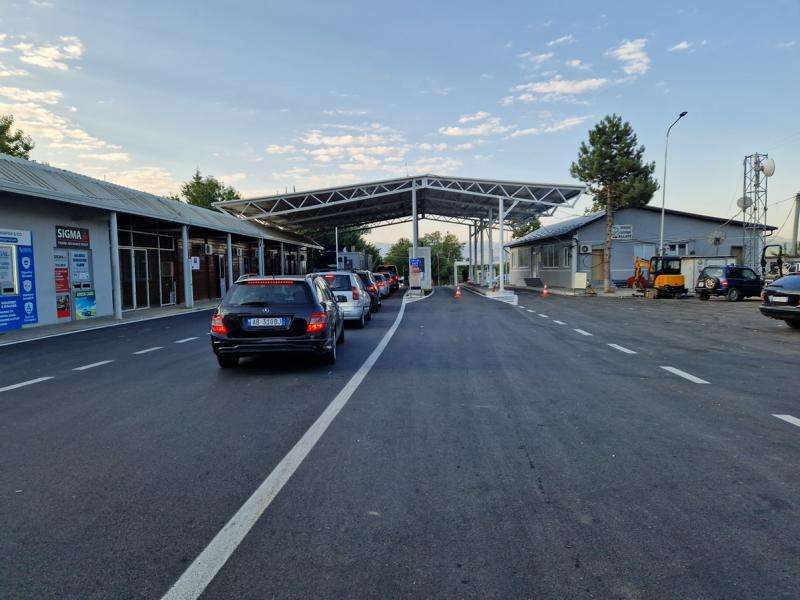
Then I have a choice to make. When planning my route, I had opted for the old road. But now, with time running out and a tiny spark of hope returning after my rapid progress over the last 50 kilometres, I spontaneously choose the newer road.
It saves me a few kilometres. Another decisive factor is that there is hardly any traffic.

The road, however, starts off extremely steep. I struggle my way up the climb, which pitches at more than ten percent. Once at the top, the descent is spectacularly steep – and with plenty of momentum, I fly straight into the next climb.
The game repeats itself several times.
Then the road seems to flatten out. Why do my legs suddenly feel so weak? Presumably, it is still going slightly uphill.

In Ersekë, I take a small detour to a petrol station. Two cans of energy drink become mine. I pour one straight down, while the second goes into my bottle for later. It actually tastes pretty good.
In the little shop in the centre of town, I also buy some biscuits and bananas.
There are still 45 kilometres and just under 1,000 metres of climbing to go, and I have four hours left to do it. That should really be enough.
I set off again. After that energy drink concoction, my legs actually feel pretty good again. The route starts beautifully: a long descent, the sun setting and bathing the landscape in magical light.

Then another climb.
I am somehow riding in a kind of fever dream. The kilometres are ticking by nicely. The road is deserted, very twisty and an endless succession of ups and downs.
At a fountain, I stop once more and refill my water supplies.
At some point, I see a light behind me.
That must be Samuel.
We will probably be the last two riders to have our cards stamped at CP4 in Leskovik. One hour before the cut-off. One hour later it will be midnight, and the final checkpoint will close.
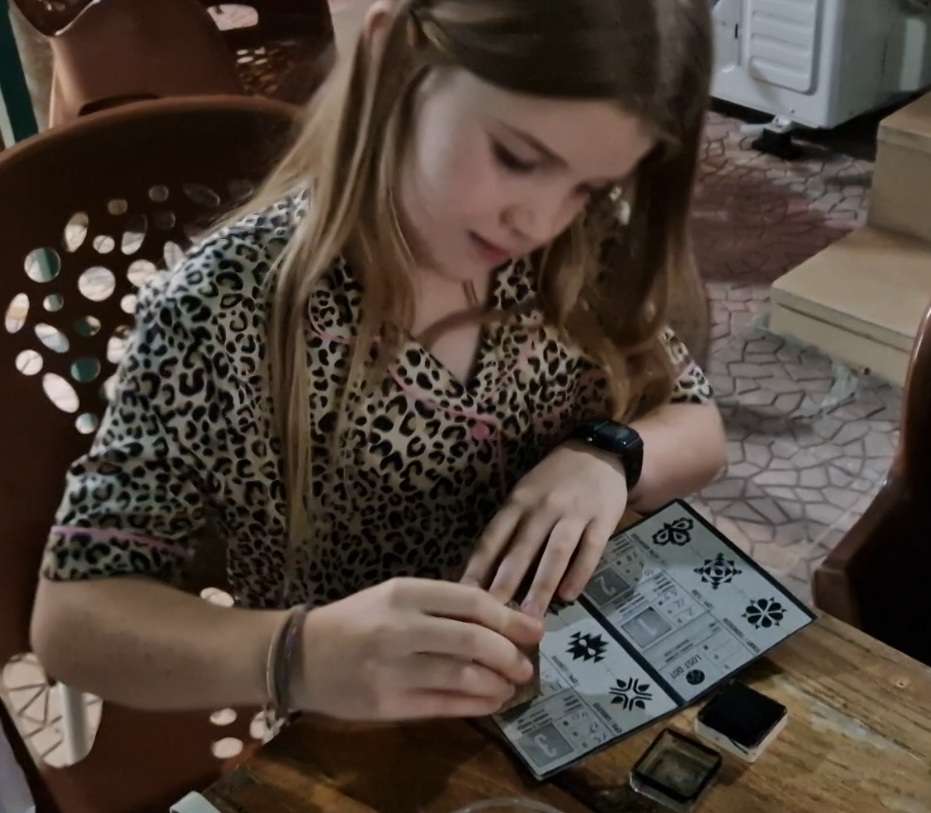
We are given a proper welcome. Oliver, whom I had already met at CP3, is there too and is delighted to see us.
At CP4, a very special stamp officer is waiting for me: Georgie. She must be eight or nine years old and, under the expert guidance of her dad, gets to press my fourth and penultimate TCR stamp into the card.
It’s not quite as easy as it sounds, though. The ink pad has apparently already covered more TCR kilometres than some of the riders and is running seriously low on ink. The first attempt is therefore a little pale. So, one more try.
This time, perfect.

Georgie does her job with a concentration that would make some adult TCR riders look rather envious. Stamp done, mission accomplished. I ride on with my penultimate stamp – and a pretty big grin.
The kind hostess at CP4 arranges two rooms for us. I am simply grateful that I made it – and that I can even sleep in a real bed tonight.
← Back to the TCR overview with all stages
Next: CP4 to the finishline Kalamata →


