first my Video day 1 to 3 (Start – CP1):
Sun, 19 July – Start Parcours
196 km · 2,250 m elevation gain · 9:30 h
Here we go. Not long after the start, on the very first climb: Bang. A puncture. Poor guy. I probably would have given up right there. But for now, I’m still feeling good. I chat with a few people I know – including Jesko from Taunus Bikepacking and Malte.
The first obstacle doesn’t take long to appear. After a climb comes a pretty steep gravel descent. Lots of riders are walking. With my 40 mm Schwalbe Allroads, I’m doing just fine. For now, anyway. I wonder how they’ll hold up over 5,000 kilometres? I’m obviously not carrying a spare tyre – purely for weight reasons. You have to set priorities.
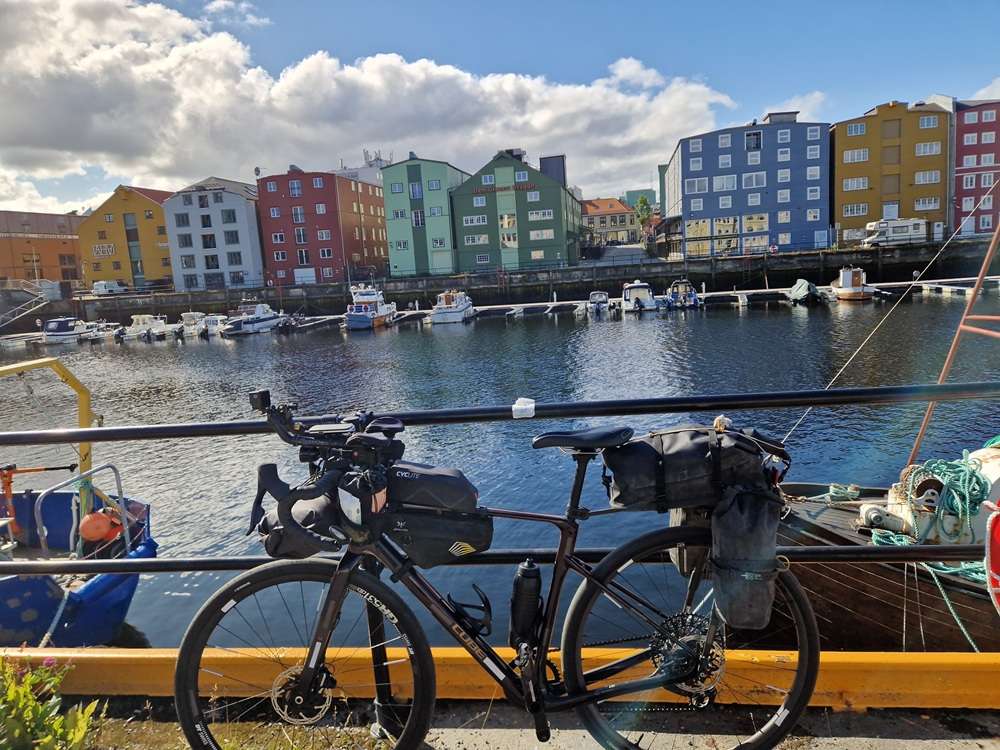
At the roadside, there’s a sign: “First TCR mountain conquered!” Well, if that isn’t a good sign.
The descent is fun. I fly down, enjoying the feeling – and then suddenly there’s a loud noise. What was that? Someone must have dropped something… I look suspiciously over my shoulder. And then, out of the corner of my eye, I see my smartphone bouncing across the road. Oh no! A pothole had launched it out of my food bag, where I keep it while riding. Apparently, after just a few kilometres, it had decided to go its own way. Full emergency stop. Walk back. Pick up phone.
And as I pick it up, one thought is screaming at the back of my mind: What if it doesn’t work anymore? What if I’ve destroyed it? Miraculously, it still works. Phone incident No. 1. I hope there won’t be a second one.
Soon we’re riding along the coast. Beautiful. The sun is slowly setting, and there are still plenty of riders around me. I wonder what it will be like over the next few days. Will I see any of these people again? Who will make it? Who will give up? And how far will I actually get?
To pass the time, I try to memorise some of the CAP numbers. Later, I might be able to “stalk” them on FollowMyChallenge – assuming I ever have time for that.
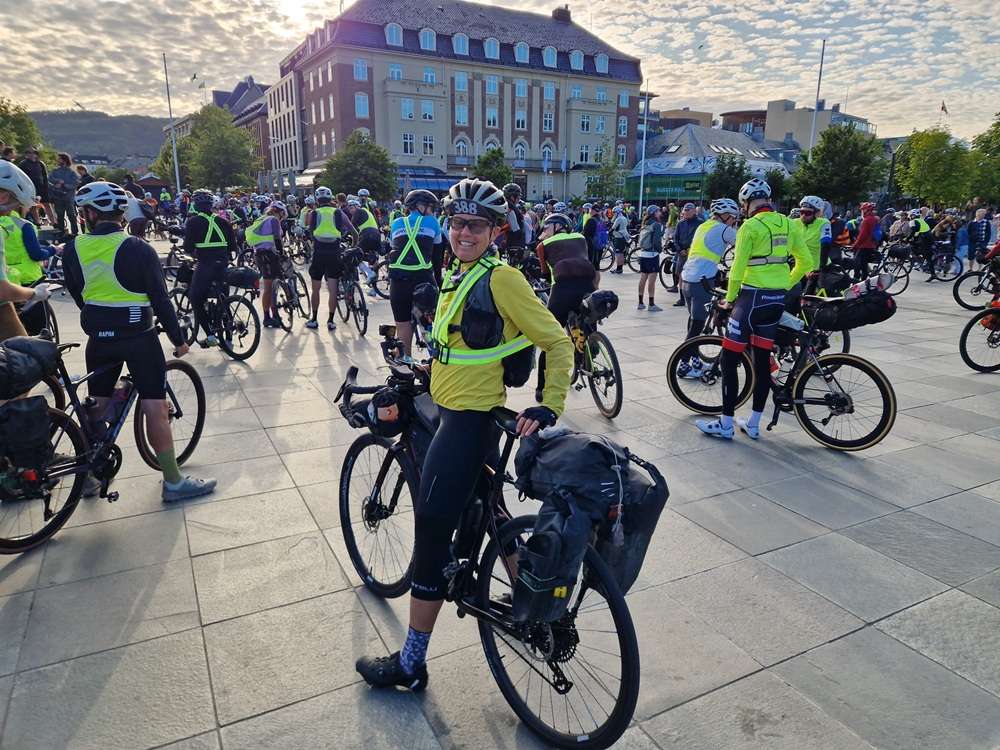
Slowly, it becomes “night”. Although calling it night is perhaps a little exaggerated. It’s really just getting dim. Even after midnight, it still isn’t properly dark. I envy the teams around me. Being out here with someone else must feel pretty nice right now.
Still, I enjoy the landscape. The neat red wooden houses, the little villages, the silence. At one house I think: if this were my normal bedtime, I could easily imagine setting up my bivvy right here on that perfectly manicured lawn. In Norway, wild camping is generally allowed – but obviously not right next to someone’s house. And I’d probably wake up with even shorter hair the next morning anyway. Mine is already very, very short. I wonder whether a robotic lawnmower can tell the difference between grass and hair?
Kilometre 111 – Sleep attempt
On Street View, I had marked a petrol station with covered picnic tables. A good idea, I thought. Apparently, several TCR riders had exactly the same idea. One table is already occupied. The three of us head for the remaining one. A little race begins. A man hurriedly overtakes me. We reach the coveted table almost simultaneously. I’m faster. The table is mine.
Susi arrives as well. The other rider reluctantly looks for somewhere else. Susi and I already know each other from our pre-start contact. She settles in underneath the table.
I spread out my groundsheet, sleeping mat and thin sleeping bag. I put on absolutely everything I’m carrying – including rain jacket and rain trousers. Then I crawl into my sleeping bag until only the tip of my nose is sticking out.
And after just a few minutes, my teeth start chattering. There is absolutely no chance of sleeping. Annoyed, I get back up shortly afterwards and pack all my stuff again. My Garmin says +2°C.
It’s just before 2:30 a.m. And outside, it’s already broad daylight again. Wonderful.
I set off and meet Karin. We ride together for a few kilometres and chat. Technically, in an unsupported race, you’re not supposed to ride with someone else for an extended period. That’s one of the rules. But I suspect the organiser isn’t going to be quite so strict with the last riders.
Karin is riding solo too. Her husband Alexander is also taking part, although he’s already further ahead. She already knows she probably won’t make it to the finish – her return flight was booked far too early. At least she had more luck than me that night: she managed to sleep in a heated toilet. Lucky woman!
A few kilometres later, we reach the Coop supermarket that had been mentioned during the briefing. David, one of the race organisers, had pointed out some important things about it. Unfortunately, my rather sparse English hadn’t taken everything in, so I’m a little surprised. It takes us quite a while just to get into the unmanned 24-hour supermarket.
Inside: chaos. More than 300 riders must already have helped themselves. The supply of fresh food is largely gone. I buy whatever still looks edible and pay at the self-service checkout.
Still shivering from the cold outside, I slump down at the table that was presumably put there for us. And then I discover that the riders before me have left quite a bit behind. I help myself. By now, the place looks more like a battlefield than a supermarket.
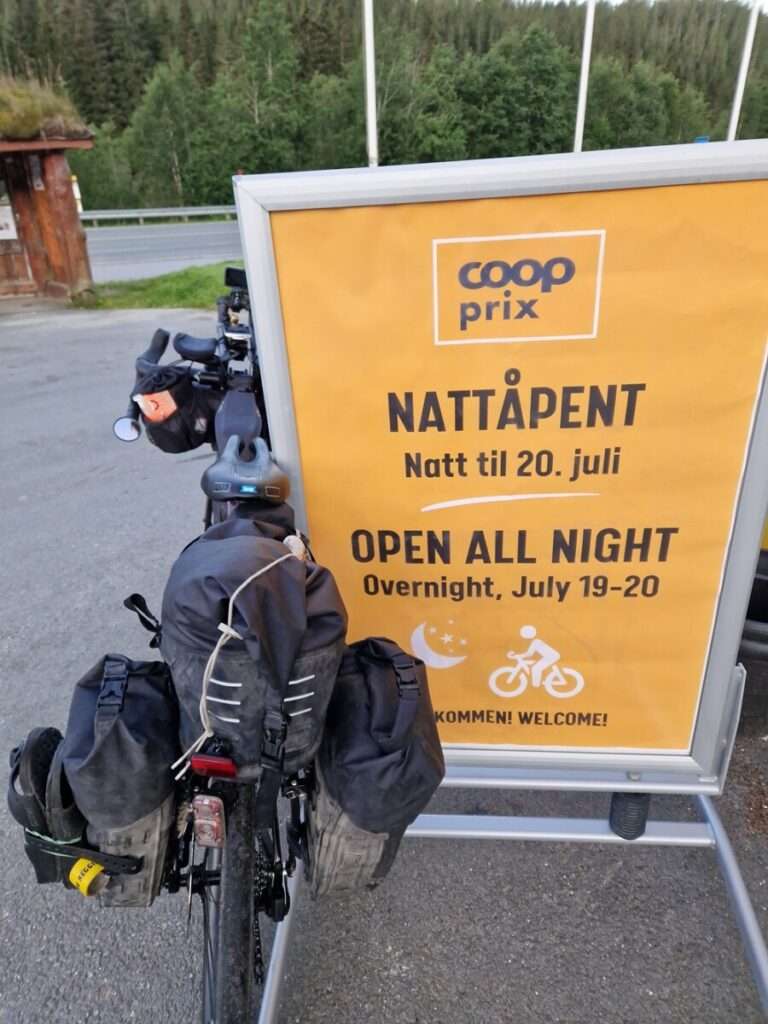
The other riders stay inside the warm shop for quite a while longer. Understandable. I ride on. After all, I have to make it to Kalamata on time. There isn’t much room in my schedule for wasting time – tempting as it may be.
And then the first trucks appear. Multi-axle monsters, travelling fast and passing pretty close. I can’t help wondering whether the drivers actually realise how little space there is between their truck and me. I’d rather not know the answer. This is probably just a small taste of the traffic that awaits me later in the Balkans.
It’s now eight in the morning. I’ve been riding for around twelve hours. And now I’m supposed to imagine eventually arriving all the way down there? 260 kilometres every day? I’ve managed about 180 kilometres so far. And already, every single pedal stroke feels heavy on the climb towards Røros.
Then another thought creeps in – one I really don’t like: The coming night. If I’m this exhausted now, where am I going to sleep? A hotel wasn’t really part of the plan. And will I even find somewhere to stay?

Sleeping outside? At these temperatures, I can hardly imagine it. And even if I find a sheltered spot, I can’t just lie there comfortably for hours.
I have to be at Checkpoint 1 in Flåm by 11 a.m. on Wednesday. Otherwise, I’ll be out of the race on day three. For me, that is damn tight. Perhaps Lost Dot – the organisation behind the TCR – simply wants to thin out the field a little by then.
Another truck approaches. I make myself as small as possible and hold my breath. As if that were going to help.
If I want to reach CP1 on time, it probably means very, very little sleep tonight. And probably the night after that, too. I have no idea whether I can do this. But I’m going to try.
At least there’s one positive thought: it isn’t raining. Getting wet in these temperatures as well would really not be a good idea.
And eventually, the end of the Start Parcours actually comes into sight. The sun is higher now. It’s getting a little warmer. And I keep riding. I’m still in the race.
Mon, 20 July & Tue, 21 July – From the End of the Start Parcours to Parcours 1(a)
305 km · 3,200 m elevation gain · 16 h
Røros. Breakfast at a petrol station. I chat with a few other riders. Actually, I don’t want to leave anymore. The waffles are delicious, the coffee is great – and after the first night, a little personal grooming feels pretty good too. But eventually, I have to move on.
From Røros onwards, my fellow riders start spreading out in all directions. From here to the next mandatory parcours at Lake Vinstra, everyone has to plan their own route. There is no official course. I wonder whether I’ve found the ideal line.

The next 100 kilometres roll along nicely, anyway. Past Tolga, then another stop at a bakery. Again, delicious. And again, I run into two or three other TCR riders. I’m slowly getting the feeling that in this race, you keep bumping into the same people over and over again.
Then it gets warm. And I’m exhausted. So exhausted that I’m yawning almost continuously. Just before Folldal – by now I’ve been in the saddle for around 320 kilometres since the start – I spot a bus shelter and treat myself to a power nap.
Ten minutes. I lie down, close my eyes – but I can’t fall asleep. So I carry on.
In Folldal, I miss the supermarket, which is slightly off my route. By the time I realise, I’ve already ridden too far downhill. No turning back. I still have enough food in my bags, but nothing fresh anymore. No kefir, no fruit, nothing I particularly fancy right now.
Much more worrying, though, is the water. It’s slowly running out. And the next reliable place to refill is still about 80 kilometres away.
My phone is worrying me too. There haven’t been many descents today where I could have charged it using my hub dynamo. Quite the opposite: the battery is draining much faster than I can recharge it. Help! I need water. And electricity.
At a lake, I spot a little watersports centre. Perfect! Unfortunately, the bar is closed. So I carry on.

Then I come across a small petrol station with an adjoining campsite. Just ahead of me, a rider comes out of reception carrying bed linen.
Sleep? Here? Already? No way. It’s far too early for me. But I could eat. And then I discover the buffet.
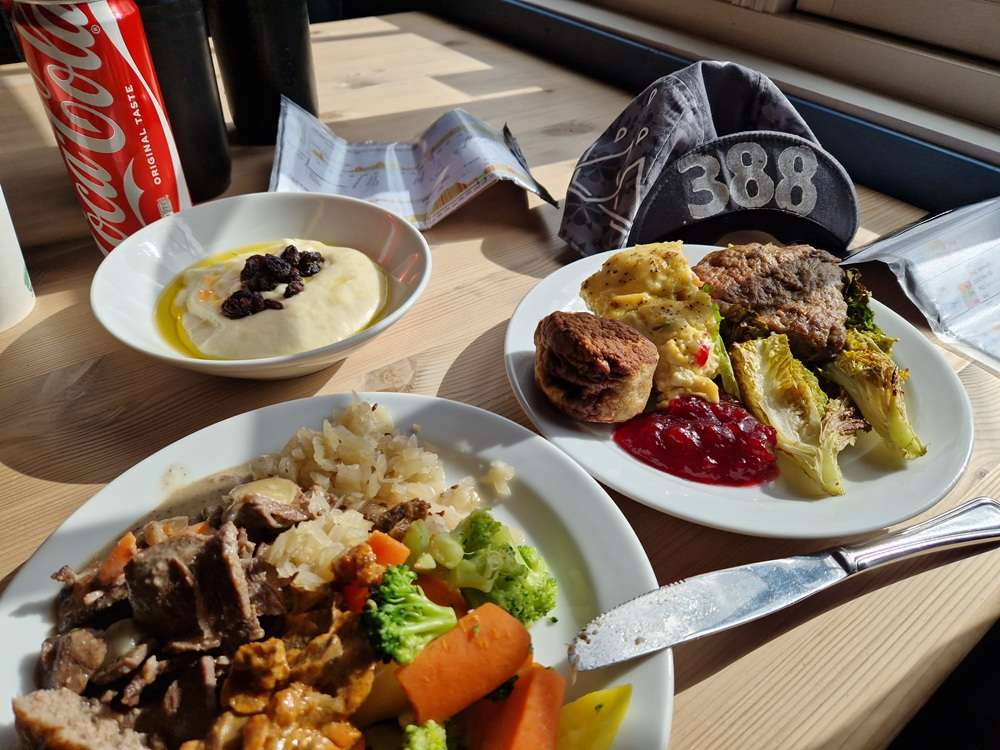
There is an absolutely incredible spread at the Atnasjø Café. Atnasjø Café I pay and proceed to work my way through practically every course. Vegetables, salad, Norwegian specialities, some kind of creamy semolina pudding, various desserts – and naturally, seconds of everything.
The other riders have modestly taken one plate each. I have three in front of me. Shameless? Maybe. But it’s delicious. And I’m hungry.
I can also finally refill my water here. And then it happens. When I get up, my chair tips over – my hydration pack wasn’t properly closed. Two litres of water spill all over the floor.
I apologise profusely. How embarrassing. Of all places. After my shameless attack on the buffet. So this is how I say thank you. Well, as I’ll discover over the course of the race, with every kilometre my inhibitions will gradually disappear anyway. Eventually, they’ll vanish completely somewhere in the middle of nowhere – just like I occasionally will.
I hope the staff see my little accident as a contribution to floor cleaning.
Then I start pedalling again.
A little later, I reach a construction site. And this is where the road climbs steeply for several kilometres. In places, more than 12 percent. With more than 22 kilos of bike and luggage, and almost 400 kilometres already in my legs, this is pretty much the absolute limit of what I can still pedal.
I don’t want to walk. But the thought is definitely becoming more attractive.
Eventually, I reach the top of the fjell. No more forest anywhere. No sheltered little spot where I could simply pitch my tent. Instead, the road continues up and down, past lakes and through a landscape that is breathtakingly beautiful – if you’re not desperately trying to figure out when and where you’re finally going to sleep.
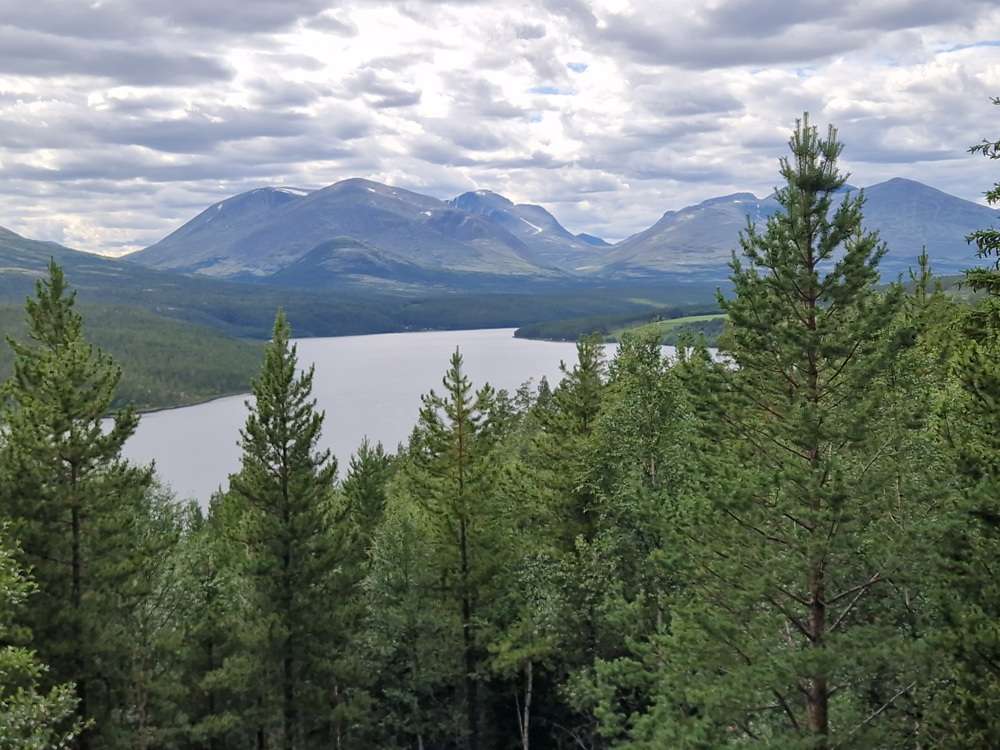
I have to sleep tonight. Again and again, I calculate whether CP1 is still achievable. Surprisingly, I’m actually still slightly ahead of my schedule.
But the hotels I had noted down in the valley 30 kilometres further on? All fully booked. And even if one had a room, I probably wouldn’t get there until well after midnight. So what now?
The sun is slowly disappearing behind the clouds. It’s getting seriously cold. What do I do? There’s still a descent of around 800 metres of elevation ahead of me.
And then I see it. A hotel. Up here. I could at least ask. It’s actually still a little early for me, but by now I really don’t care what the original plan was. I need sleep.
Venabu Mountain Hotel. I walk in. Yay! There’s a room available. The €170 for what will probably be about four hours of use doesn’t hurt at all. At this moment, sleep is priceless. Venabu Mountain Hotel
I can even wash my bike. This will be the only time during the entire race that I waste precious time on something as unnecessary as bike cleaning. At least I get some oil onto the chain too – and that, admittedly, is important.
In my room, I even get a little breakfast with fruit and muesli. For the next day, they also prepare a packed lunch for me.

Before going to bed, I check several times that I’ll be able to get out of the hotel easily at around four in the morning. Over the years, I’ve had some bad experiences with hotels where the night-time exit seemed to be designed more as a climbing route. This time, I really don’t want to have to climb out of a hotel window.
The bike is washed. The chain is oiled. My stomach is full. My water bottles are filled. And there is a bed. Now I just have to sleep. For a few hours, this feels like luxury.
And then it’s onwards towards CP1.
Tue, 21 July – Across the Fjell to Flåm
It isn’t quite dark yet when I set off again. Or perhaps it isn’t quite daylight yet? Even Susi is still here – her bike is still standing there in the morning. The night before, we had shared the “bunk bed” underneath the picnic table.
Towards Parcours 1(a), there’s a descent first, followed by around 20 kilometres through a valley before the climb towards Jotunheimvegen begins. Here I have a choice: a longer asphalt route, about 30 kilometres extra, or the gravel route across the fjell. Since the weather is dry, I choose the gravel option. It’s supposed to be spectacularly beautiful. And saving 30 kilometres is, of course, another good argument.
After about 30 kilometres, however, I realise that something is missing from my cockpit. My GoPro is gone!
How can that be? In the twilight, I must not have secured it properly in the bike garage at the hotel. After that came a gravel section with quite a few potholes, and the asphalt wasn’t exactly smooth either. At some point, the poor thing must have decided to leave me.
I ride four kilometres back. Nothing. Losing the camera itself would be annoying but manageable. But the footage since the start is gone. So sad!
I’m pretty frustrated. From now on, I’ll have to film with my smartphone again. Phone incident number one had at least ended happily. Now: GoPro incident number one – and probably the last one.
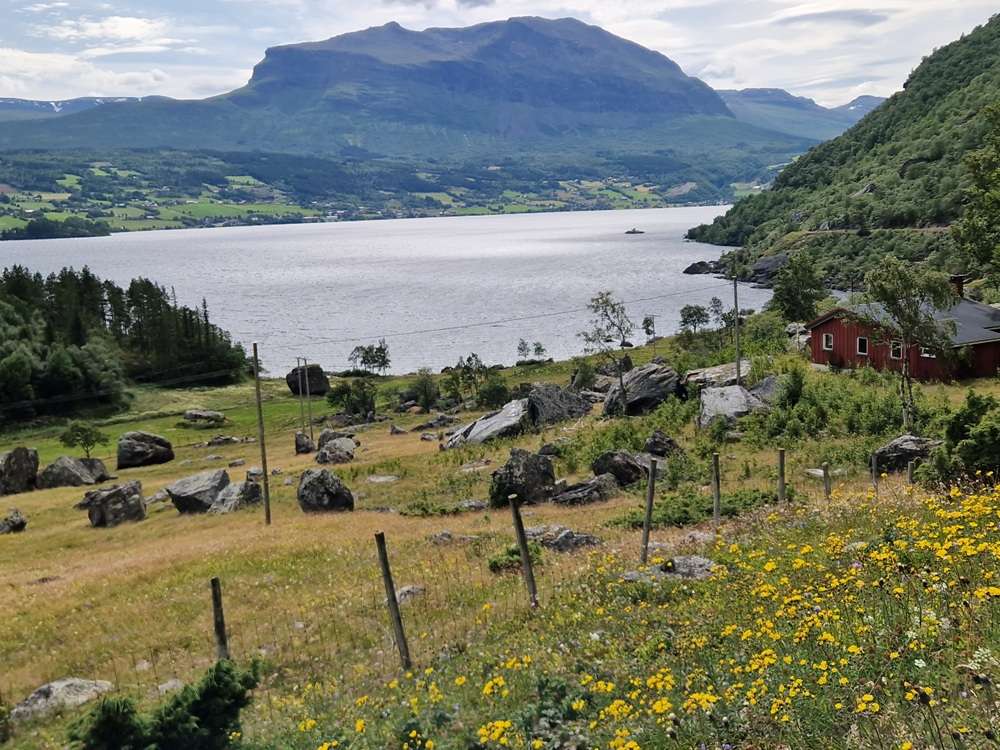
After around 60 kilometres, by now early in the morning, I’m just before the actual gravel section. A first food stop to refuel, and then I continue.
At the top of the fjell, I stop for some photos. Kiki and Andreas, whom I’ll be seeing quite a few more times from now on, overtake me. The two of them are approaching the TCR adventure somewhat differently: light luggage, which makes them faster – and a hotel every night. Enviable!
I, on the other hand, am carrying my entire household and therefore travelling at a decidedly snail-like pace. At least I always have my hotel room with me. In theory.
Postscript: The two of them are using their ride to raise money for a wonderful project. I did something similar during my NorthCape4000, but this time I decided I didn’t have the energy to go around “begging” people for donations again. Perhaps someone would like to join in here. Kiki and Andreas are putting the donations to very good use. Cycling for Mutoto
I manage to get a photo with them, but I can’t catch them again. Over the next few hours, I seem to make an endless number of tiny stops: sunscreen on, arm warmers off, leg warmers off, a little later back on again. The wind is blowing cold across the fjell. Jacket on. Jacket off. Back on. Back off.
At least the surface is, as someone put it so beautifully, “champagne gravel.”
Around midday, after an unpleasantly pothole-ridden descent, I finally reach the start of Parcours 1(a). Several TCR riders are coming towards me. At first, I’m confused. Then I realise what’s happening. Those who chose the asphalt option arrive at the other end of the parcours – and then have to ride the entire gravel section back in the opposite direction. Suddenly, I’m quite happy with my decision.
One more series of climbs and descents, and I reach Beitostølen. And finally, my first proper resupply point in many, many kilometres. Actually, for me, it’s the first proper one in almost 20 hours.
Wonderful! The supermarket has everything I could possibly want. I eat my way through the shelves and stock up at the same time for the rest of today and the next day. As far as CP1 in Flåm is concerned, I assume there won’t be anything else.
As so often happens in the TCR, I’m wrong. About 60 kilometres later, there’s another place to buy food.
So I continue dragging my completely unnecessary stockpile around with me. Especially water. I carry it over the mountains and then pour it out again as soon as I find somewhere to refill. I hoard water because I don’t want to run dry.
By now, the area outside the supermarket in Beitostølen has become a meeting point for more than a dozen riders. I stay there far too long. I get interviewed and am supposed to speak English. What comes out is probably an interesting mixture of English and imagination.
I should point out that no native English speaker has ever corrected me. Only a few kilometres later, during the next coffee stop in a cute little café run by two young women, a German tells me that you can tell from my sentence structure that my English isn’t particularly good.
Thanks!
TCR life can be funny sometimes. You ride with someone for a while, struggling through a conversation in broken English – until eventually you discover that you both speak German. Suddenly, everything becomes much easier.

Onwards.
Looking back, I’m no longer sure that my route choice that day was quite as brilliant as I thought. Countless times, the road climbs steeply and then drops steeply again. The road follows Lake Vangsmjøse, but an incredibly strong headwind slows me down. Then the surface keeps switching between asphalt and gravel.
The E16 runs through the valley. Its tunnels are forbidden to cyclists, so I repeatedly have to take the old roads around the outside. The traffic on the E16 is unpleasant, and there are climbs too – plus, by now, quite a bit of heat.
In Tyinkrysset, I unexpectedly discover another supermarket. So: more hoarding. And more carrying.
At least the next 70 kilometres are mostly downhill. Together with several other riders, I descend, partly on the E16. Here the road is pleasantly wide, and further down the traffic is diverted once again.
The landscape makes up for a lot: huge gorges, waterfalls and cultural monuments.
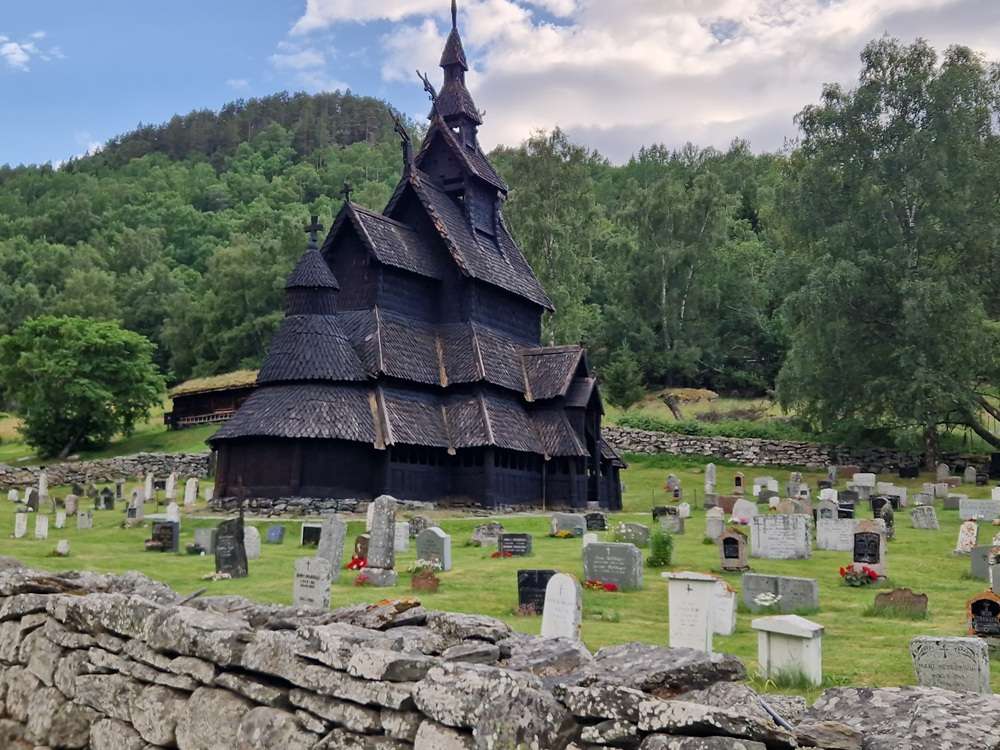
In Borgund stands a weathered, almost black stave church. These medieval wooden churches are among Norway’s most distinctive buildings. The name comes from the vertical wooden posts that support the structure. Of the many stave churches that once existed, only 28 remain today, most of them in Norway.
Onwards towards Lærdalsøyri. It’s now early evening.
And then I see the tunnel entrance.
Oh, how wonderful it would be to simply ride in there now and take the shortcut to CP1.
At 24.5 kilometres, the Lærdal Tunnel is the longest road tunnel in the world and leads directly to Aurland. But of course, cyclists are not allowed to use it.
So I have to cross the fjell. From sea level, I climb to around 1,300 metres, cross the plateau and then descend again. At the other end is the much-coveted CP1. I have to be there by 11 a.m. the following morning.
Time for another calculation.
It’s now after 9 p.m. According to my plan, I need around five hours for the remaining 54 kilometres and roughly 1,400 metres of climbing.
Five hours!
But what if I’m slower? After all, I’m carrying a lot of stuff.
And thick clouds are gathering overhead. When I reach Lærdalsøyri, it starts to drizzle. I shelter in a bus stop and think.
What do I do? A long sleep isn’t an option. And pitching my tent in the rain? Oh dear.
I try Booking.com to find accommodation in Lærdalsøyri. Nothing. Everything is fully booked. I ride to a campsite with little cabins. Full. Then to the nearby hotel. Also full.
At least the rain has stopped by now. So I continue.
Shortly after the turn-off towards the plateau, I find exactly what I need after crossing a bridge: a small meadow, slightly away from the road.
Perfect.

I quickly pitch my tent. The rushing stream beside me will surely lull me to sleep. And indeed, I fall asleep.
For exactly four hours.
Then the alarm goes off. Pack up. Move on.
Although it isn’t even four in the morning yet, it is already – or still – broad daylight. There’s no sunshine to be seen, though. The thick clouds are still hanging over the mountains. And higher up, they appear to be about to empty themselves.
I think it, and almost immediately it starts drizzling. Rain gear on. And just as quickly, the rain stops again.

The narrow road winds its way upwards. I’ve been here before, during the Norseman Triathlon. I can hardly wait to get up onto the fjell and fly across it.
Up there, it’s beautiful. And bitterly cold. And windy. I put on everything I have. Campers are parked everywhere. They’ve got it good. Sleep in. Have a leisurely breakfast. But this is what I chose to do.
On the descent, my handlebars shake in rhythm with my trembling arms.
Then I reach the Stegastein viewpoint.
And suddenly, my heart feels warm. And all thoughts of the cold disappear.
The view over the Sognefjord is simply indescribable. I have tears in my eyes. Not just because of the cold.
How wonderful it would be to share this moment with someone. Someone special.
But there’s no time for self-pity. Move on. The clock is ticking.
At least I still have around four hours until the CP1 cut-off in Flåm. From Aurland, it’s only a few kilometres. With a little time to spare, I reach my first major goal.
In sunshine, I ride through the crowds in the little town. A huge cruise ship is anchored offshore and has disgorged its entire human cargo into this tiny village.
Flåm is bursting at the seams.
I stamp my card at the checkpoint, do a quick bit of body and clothing maintenance, and use Google Maps to find the supermarket. Of course, I don’t find it immediately. Google Maps shows me the way – and apparently I decide to take a different one.
So much for my navigation skills.

Annoyed by my detour, I’m tempted to head straight for the Rallarvegen. But I can’t afford to. For today, and probably well into the following day, there won’t be many opportunities to buy food.
Susi is there by now too. We have a lonely but joint “breakfast” outside the supermarket. Then she says goodbye. I won’t see her again on my journey through Europe.
It’s time for me to leave too. There’s nothing I can do about the suspicious looks from the immaculately dressed cruise passengers.
If only they knew.
The next highlight is already waiting for us:
The Rallarvegen
For more than 52 kilometres, mandatory Parcours 1(b) follows the gravel track of the old railway line all the way to Finse. From there, another 30 kilometres of gravel take us to Haugastøl. I have no idea how long this is going to take.
I’m allowing up to ten hours. We have to ride this popular cycling route in the opposite direction to the tourist crowds. And getting to Finse means around 1,600 metres of climbing.
It’s just 10 a.m.
Let’s see where I’ll be tonight.
Originally, I had planned to find somewhere to stay in Geilo, more than 100 kilometres further on.
But by now I’ve learned something about the TCR:
“Originally planned” is a very flexible concept.
Back to the ←TCR overview with all stages
Next: CP1 to the ferry to Ystad →