
first my video day 11 to 14:
Halfway? Day 11 – Thu, 30 July
CP2 to Tarnalelesz | 240 km | 2,050 m elevation gain | 12 h

After the longer break stay at the wonderful guesthouse Penzion Fortuna, I am now a few kilometres behind my schedule.
Considering the distance I still have to cover, this is not a problem yet. As long as these little delays don’t keep adding up over the next few days, I should still make it to the finish on time. At least I reached CP2 with half a day in hand before the cut-off.

After breakfast I set off feeling motivated, initially following a lovely cycle path along the river. Unfortunately, I soon have to turn onto a main road. I had imagined the way to Poprad would be more or less flat, but I am quickly proved wrong. Before long I have climbed more than 500 metres, and on top of that it is getting seriously hot. To be honest, I already use the sprinklers at a children’s playground as a shower. And after the first 40 kilometres, I spontaneously cancel a detour into the hills with yet more climbing. There are moments when you simply have to set priorities.

Then I have one of those sudden déjà-vu moments. The mountains to the north look strangely familiar. Surely I have been here before! I dig deep into the furthest corners of my brain and, amazingly, find the answer: four years ago, during the NorthCape4000, I came through the Low Tatras and some very remote areas. I spent the night in a village and then crossed north towards the High Tatras. And those are exactly the mountains in front of me now. I even cross my old route and see the sign for a place with just one vowel at the end: Štrba.
Suddenly the memories come flooding back: the colourful silhouette of the village I approached at dusk and the very simple accommodation with its wonderfully friendly hosts. It is a lovely feeling to be passing through here again four years later – this time on my way to Kalamata.

Only a few more kilometres to Poprad. The traffic gets heavier and heavier. Every now and then I can escape onto a short section of cycle path, but then I have to turn south again.
Via Betlanovce I enter Slovenský raj, the Slovak Paradise. Near Píla I ride right through this impressive landscape of dense forests and deep gorges. At first I am still wondering whether this was really the best choice. The road climbs steadily alongside the cool Veľká Biela voda. It is almost completely shaded and there is hardly any traffic anywhere. It is incredibly quiet and peaceful – the only sound is the stream beside me. A few more bends and I reach Kopanec Pass, the highest point of this section.
Then comes a fast descent and I arrive in Stratená – Verlorenseifen. Even the name makes me smile. After several days without a proper shower, I actually feel a little as if I have “lost my soap”. Somehow, the name could not be more appropriate. I take it as a good sign and keep riding.
After lunch, the road takes me downhill towards Dobšiná. The town looks rather run-down to me. Many of the houses clearly haven’t been renovated for years, and some of them look genuinely sad.
I stop at a small, rather dilapidated supermarket. With my shopping – almost a litre of kefir, Müller rice pudding and the fruit and vegetables I was allowed to take from breakfast – I sit in the shade outside and try to rest for a while. Hardly have I sat down when a rather strange man starts talking to me. I don’t really understand what he wants, and I don’t feel particularly comfortable here. There are also groups of teenagers hanging around.
In general, I have the impression that the people are watching me with just as much suspicion as I am watching them. Maybe it is simply the unfamiliar surroundings. Either way, I am relieved when I can pack up my things and continue.
Out of the valley, I follow the Slaná. The further down I go, the fewer trees there are to provide shade. The heat becomes brutal.
Once again, a fountain has to serve as my shower. I give myself a full-body wash, soak my cycling jersey completely and put it back on dripping wet. Wonderful – at least for the next few kilometres.
But there is still a small climb in the way: three kilometres and 170 metres of elevation gain. Normally that sounds like nothing. In the blazing sun, however, it turns into quite a torture session.
Luckily there is hardly any traffic. The few cars that do come along, though, seem to be in an incredible hurry. They race up the hill that takes me from one valley to the next. Suddenly the tyres of an approaching car screech horribly. I think the driver only sees me at the very last moment. I am instantly wide awake.
In the next village I find a tiny shop with a few men sitting outside, watching me curiously. There isn’t much to choose from, so I buy a Coke and an ice cream. I ask if I can sit inside for a while in the cool of the shop. Shortly afterwards, however, the owner closes – and it isn’t even 5 p.m. Half the ice cream ends up in the bin. The wafer is completely soggy and the taste is rather strange. Clearly, the cold chain has been interrupted a few times. I really hope I don’t have any problems because of it. Salmonella or something similar would be about the last thing I need right now. I would rather not have my TCR adventure end because of a questionable ice cream.
At Gemerská Hôrka I have to take a detour. The road towards Bohúňovo is forbidden for me, so I have no choice but to make a wide loop. At least the route takes me through beautiful agricultural countryside – unfortunately, it also adds about ten kilometres.
Near Tornaľa, just before the Slovak-Hungarian border, I am back on my route. I stop briefly at a supermarket. Outside, two boys approach me. They keep saying “ku … ku …” and pointing at my closed bikepacking bag. I don’t understand a word. After a bit of detective work, I finally realise what they are trying to tell me: they want to sell me kukurica – corn on the cob.

A woman then happily takes my rubbish from me. Perhaps she can make a few cents from the bottles and cans I have returned for the deposit? Who knows. At least I am rid of my rubbish.
The area around the border looks rather neglected. I reach Özt. There doesn’t seem to be any drinking water here, but perhaps I can at least wash myself a little and, above all, cool down.
Then, completely unexpectedly, a narrow and pleasant cycle path leads out of the long village through reed-covered land. It goes on for about 15 kilometres – beautiful and completely quiet. It is already getting dark. The cycle path is so lovely that I follow it far too long without thinking. Eventually I realise I have gone too far, turn around and have to ride back all those lost kilometres. Well, that’s TCR too.

After that, a newly paved road takes me up and over another small hill. I am talking to Hermann on the phone while riding, so the few remaining metres of climbing almost pass unnoticed.
By now I should actually have covered another 90 kilometres. The previous day, the heat had slowed me down considerably. So today I will end up with a little over 230 kilometres and around 2,500 metres of climbing.
By the time I reach Tarnalelesz, I am really tired. The lorries are still thundering past well into the evening. Do they actually know that cyclists are still out here at this time of night?
I don’t have much choice when it comes to finding a place to sleep. Just outside the village I find a field slightly below the road, with a bush offering at least a little protection. I put up my tent, set the alarm for 2:30 a.m. and plan to leave around three.
The lorries keep rushing past and the cicadas are chirping loudly. It could be pretty annoying. But tonight I simply don’t care. I am so tired that none of it matters anymore. Eyes closed – and gone.
Day 12 – Friday, 31 July
330 km | 900 m elevation gain | 14 h 40 min

Alarm at 2:30 a.m., departure around 3. Barely have I set off when a loud clattering sound startles me. A deer jumps across the road. Oh dear – I’d better pay a bit more attention. There are warning signs about wildlife crossings everywhere.
About 15 kilometres further on, I spot a whole group of animals on my right, heading towards the road and crossing it. The stream of grey-brown animals of all shapes and sizes just doesn’t seem to end. I slow down and keep riding carefully. Just when I think the last one has crossed, a huge body with antlers suddenly appears only a few metres in front of me. Deer! They seem to appear out of nowhere. I really need to be more careful, especially when I’m going a little faster downhill.
I’m clearly not completely focused today.

As I ride, I start thinking about the best way to get to Sarajevo. Before the race, I spent days planning different routes. The result is rather sobering: whichever option I choose, sooner or later I end up on busy main roads.
Then I have an idea. Robin Gemperle, the TCR winner, has already reached the finish on Day 10 – roughly as far as I got yesterday. So why not take a look at the route he used?
All those days of route planning suddenly seem rather irrelevant. I decide to simply follow Robin’s route from Osijek onwards. I still have a day to play with, and sometimes it may actually be a good idea to throw your carefully made plans overboard for a while. Of course, I have no idea yet what is waiting for me the day after tomorrow.
About 70 kilometres into the day, roughly ten kilometres before Heves, I discover a wonderful little bakery in Kál. Fresh pistachio croissants, cappuccino and something with quark – probably a Hungarian quark pastry. Of course I can’t resist. Everything disappears, and off I go again.
The sun is now climbing higher and it is getting really warm. I like the landscape, but the road is one giant patchwork of potholes and repairs. I weave around the holes while constantly having to make sure that no car or lorry is approaching from behind. Cycling as slalom training.
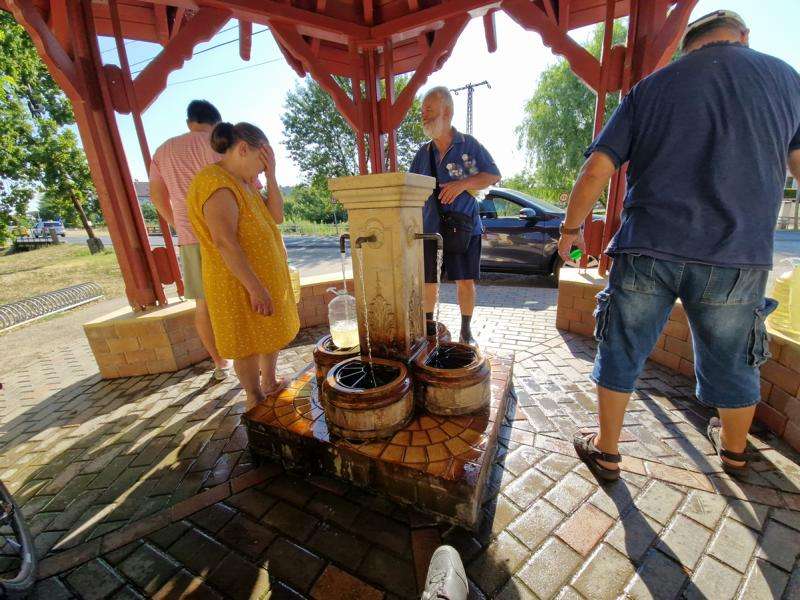
In Újszász I spontaneously stop at a fountain. Water is bubbling from four taps – but it is lukewarm and slightly cloudy and yellowish. If I’m already suspicious enough to use it for washing my hands, I certainly won’t be drinking it.
I get out some bread, cheese and yoghurt from my supplies and settle down in the shade. Gradually, more and more people arrive carrying large plastic bottles, canisters and even watering cans. They fill them with water and chat away happily. One of the men tries to explain to me that this is mineral water straight from the tap and perfectly safe to drink.

I remain sceptical. I certainly don’t drink it. But as my personal cooling system, it is excellent. Once again, I soak myself from head to toe with the lukewarm water and ride on feeling refreshed.
Today I even have a slight tailwind. It pushes me along quite nicely, but unfortunately doesn’t cool me down at all. The sun keeps blazing.
For the first time, I listen to a podcast. Normally my headphones stay in my bag – I only put them on when I really need a distraction. Today is one of those days. The episode is about Everesting and about how it is sometimes okay to say “no”.
That hits home rather perfectly. Is anyone actually forcing me to cycle all the way across Europe? And through this sometimes horrible traffic?
It makes me think of my own spontaneous Everesting adventure. One day I simply decided to ride up and down Plose Mountain, right outside my front door. I climbed it eight times until I had accumulated almost 9,000 metres of elevation gain. The bus driver, who kept seeing me every time I came back down, probably thought at some point: That woman must have a few screws loose.
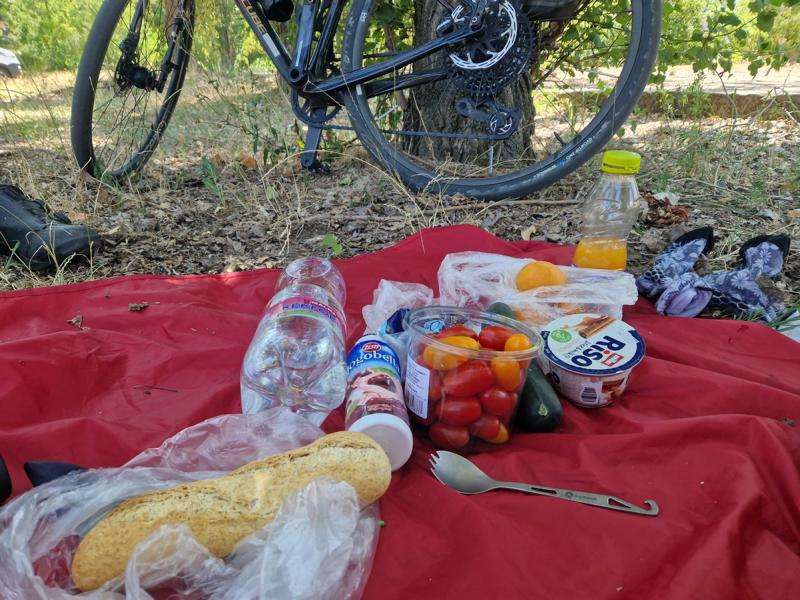
And now I’m sitting here somewhere in the middle of Europe, actually wondering why on earth I am doing this to myself. Maybe this is exactly the moment when you should say “no”. Or maybe it is the exact moment when you realise that, actually, you really do want to keep going.
Near Kecskemét, the heat becomes almost unbearable. My route runs for kilometres without a scrap of shade, along a cycle path right next to a busy road. The sun is beating down, traffic is roaring past and my Garmin climbs above 40°C.

After doing some shopping, I spread out my mat on the grass outside a petrol station. Eat, lie down, half an hour of power nap. Then I have to get going again. Before leaving, I once again soak my cycling clothes completely in the petrol station toilet. The cooling effect doesn’t last long, of course. As soon as I’m back on the road, everything is dry again.
The next few hours could probably be summed up as “survival strategy against the heat”. Every opportunity to cool down is used.
I gratefully take advantage of a sprinkler system. Shortly afterwards I pass a small supermarket. I ask if I can use the toilet – and once again my clothes get soaked. Such lovely ladies!
Next stop: a house under construction. The owners are spraying down a freshly poured concrete floor. Perfect! I simply join them.

Twenty minutes later, everything is dry again anyway. So I start asking people in a few gardens if I can splash some water over myself. They actually let me. By now, nothing is too embarrassing.
Eventually I come to a cemetery. There is water here too. And once again: soak everything and carry on.
If I can’t find anything else, the water bottle has to do the job. But not that particular one.
I had made a stupid mistake in one of the supermarkets. I wanted to buy water and, as usual, reached for the bottle with the pink label. Only later did I realise: strawberry flavour!
Sweet strawberry water. Yuck.

I pour half of it away and fill the rest into my cycling bottle. Then, every few kilometres, I force myself to take a few sips. Not exactly my favourite drink – but in this heat, every drop of liquid is precious.
The traffic on this dead-straight road is getting seriously dangerous. Especially the lorries. Some of them thunder past just a few centimetres away from me. Do they even see me?
In Kiskőrös, after stopping at Tesco, I make another quick stop at a different supermarket. I have actually forgotten the water. Damn! The heat must have fried something in my brain today. I have been stopping constantly all day. Every few kilometres, I get off the bike, pour water over my arm warmers and myself, drink something and eat. All perfectly sensible and absolutely necessary in this heat. But all those little stops are slowly adding up.
And suddenly the thought occurs to me: Will I actually make it to the finish by next Saturday?
The route is flat, but the heat is draining both strength and time. And time is something I really can’t afford to waste. Because of the two-hour lunch break in the shade and all the little cooling stops, I eventually miss the last planned evening ferry across the Danube.
Never mind. Today I will have more than 330 kilometres on the Garmin anyway. There has hardly been any climbing; the route runs almost dead straight through the Pannonian Plain. In theory, this should be a dream – flat and fast. But the heat just sits over the landscape, and even on a descent there isn’t a moment when I can simply let my legs relax. Just keep pedalling. On and on.
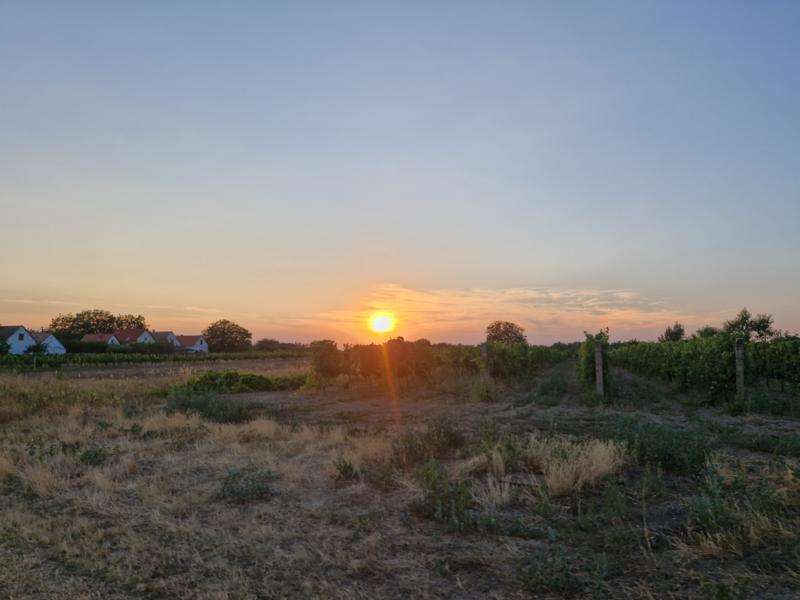
In the evening, the roughly 25 kilometres to the ferry seem to stretch out like chewing gum. There is hardly anything to see. All I can really tell from my Garmin is that I am riding parallel to the Danube. A tiny side road, hardly any distraction – apart from the lorries, of course. Ha!
By now I have the feeling that I am completely alone out here. I haven’t seen a single fellow competitor for two days. Where is everyone? Or am I actually the last one?
A suspicious glance at the app reassures me: No, I’m not.
Day 13 – Saturday, 1 August
283 km | 1,500 m elevation gain | 13 h 50 min

I set up my tent at the ferry landing on the Danube near Mohács. The first ferry is due to leave at 10 past five, so there won’t be much sleep.
While packing up my tent, I realise something: I can’t really smell myself anymore. I’ve washed my jersey every now and then, but eventually there is only so much you can do when you haven’t had a proper shower for days and your daily hygiene consists of little more than a quick wash with a cycling cloth. There is a toilet at the ferry landing, so after buying a ticket for myself and my bike, I make good use of it.

A few people are already waiting for the first ferry, with bicycles and baskets full of vegetables and flowers. The sun is just coming up, bathing everything in an almost unreal light. Beautiful!
On the other side, in Mohács, a bakery is already open this early in the morning. There is also a café opposite where I could get coffee – but unfortunately they don’t take cash. On top of that, the barman acts as if he has never heard of a cappuccino. Unfriendly! So I move on.

A few kilometres later I reach the border. Hungary is behind me, Croatia ahead.
And … there it is again: a little hill on the horizon. Finally, something for my legs to do! A whole 100 metres of elevation gain. A tiny mountain compared with the previous stages – but I’m actually happy to see it.
Shortly afterwards I reach Kneževi Vinogradi in Croatia. A bar! Surely they will accept euros here. It is still early in the morning, but there must already be about twenty men sitting inside. Not a woman in sight. Naturally, I attract quite a few curious looks.
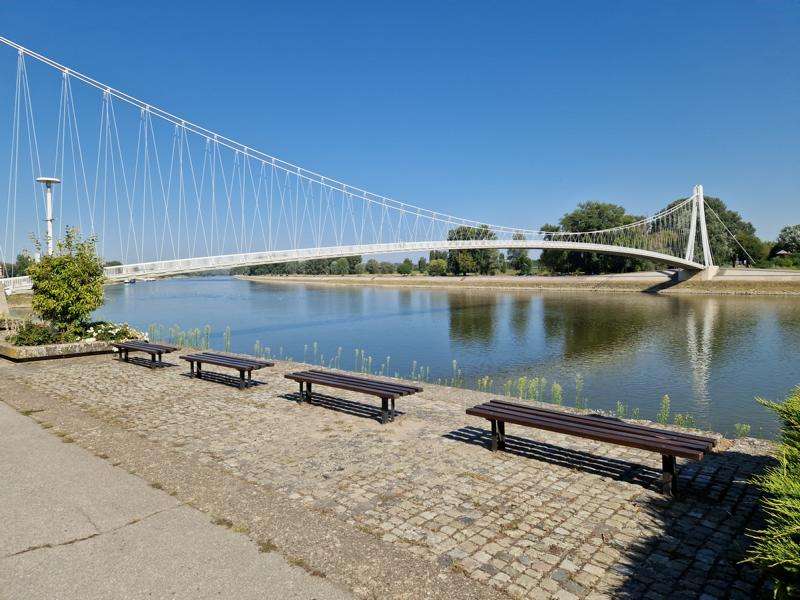
Orange juice, coffee and a croissant – perfect! In between, I quickly turn the toilet into my personal washing facility. I wash my gloves, headband and, above all, my socks, which are in desperate need of it. By now, they are almost capable of standing up by themselves.
A few kilometres later comes another shock: a bus overtakes a group of cyclists on the opposite side of the road. I have to squeeze myself as far to the side as possible. That was close!
It is getting warm again, but today the heat feels different. There is a little more air, making it much more pleasant. And I actually start seeing cyclists again. Apparently, I am on a road where drivers are used to cyclists. That makes me feel a little safer.
And in between all this, I have time to contemplate something completely different: today, it’s Oreos. Those pitch-black biscuits with the filling that I would never dream of buying at home. Here, they are practical. I alternate them with grapes in my top-tube bag, so I always have a little snack within reach.

Incredible, really: Oreos seem to taste slightly different in every country – and even the colour of the filling changes. From pale pink to turquoise, I’ve seen everything. I’ve had white Oreos too. There is actually one practical advantage to those: you don’t spend hours afterwards looking as if you’ve been eating biscuits.
With the black Oreos, on the other hand, I sometimes ride along with black teeth and black corners around my mouth. Not exactly the most elegant TCR look.
A little later, after passing several small villages, I reach Osijek.
From here onwards, I am entering the unknown. Well … as I mentioned before, Robin Gemperle has already tested this route. But whether he was happy with his choice afterwards – and whether I will be – we will probably only know tomorrow in Sarajevo.
It is around 9:30 in the morning, and I still have roughly 300 kilometres and more than 3,000 metres of climbing ahead of me before CP3. I had actually hoped to arrive there in the late morning. Now I start wondering: How late will I be? And will I even make it?
Too many riders have already dropped out of the race. Will the same fate await me? The time pressure is real. CP3, high above Sarajevo, closes at midnight.
Despite all the uncertainty, I am once again really proud to be part of the TCR. Yesterday I had doubts several times, for all sorts of reasons, and actually wondered whether I should quit. If only getting out were that simple. How would I even get home from here? Croatia isn’t exactly the other side of the world, of course. But from this easternmost corner of the country, getting home would hardly be a walk in the park.
And then my first dog starts following me.
Fortunately, it’s only a small one – probably some kind of introductory model. A little barking, a few metres running behind me, and then he loses interest.
Well then. TCR dog number one. There’s probably more to come.
After three days of riding almost exclusively across flat terrain, the elevation gain finally starts to increase again. How is this going to feel?
From Osijek, the route continues through fields, meadows and small villages. In Vinkovci, I stop at a supermarket. Unfortunately, there is no toilet where I could at least give myself a proper wash. So I carry on.
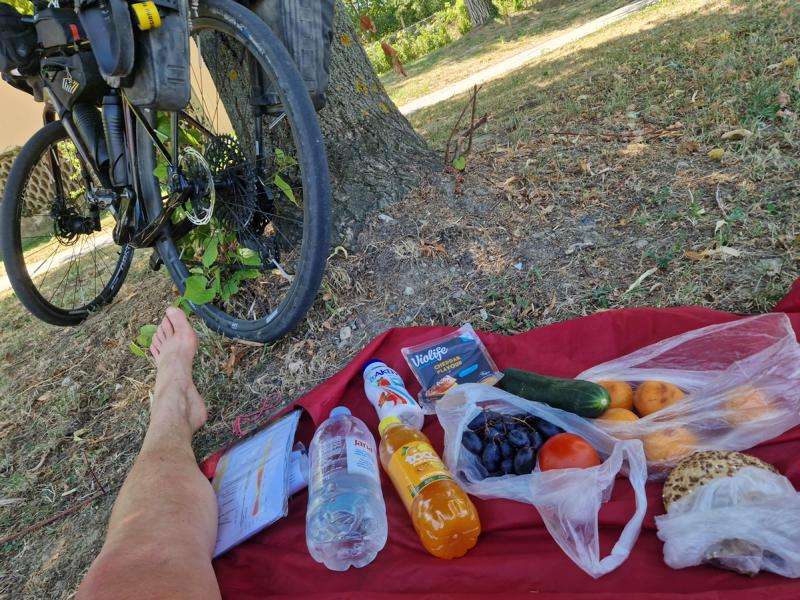
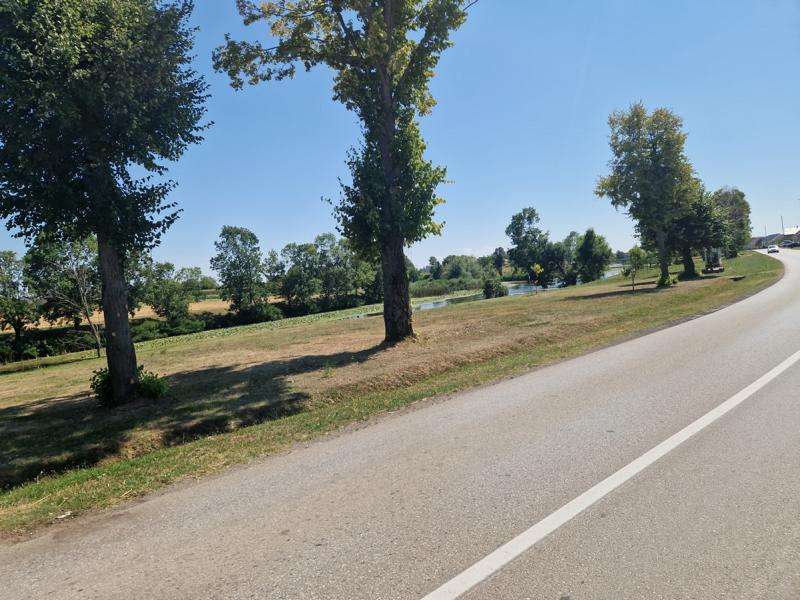
Ten kilometres later, I stop again in Andrijaševci. There is no shade near the shop, so I simply ride back half a kilometre. On the way there, I had spotted a little park beside the Bosut river – perfect for a lunch break. Eat, lie down, power nap. As usual around midday.
And sure enough, I see another rider passing by. So I’m not completely alone after all.

I am getting closer to the border between Croatia and Bosnia and Herzegovina, at Županja / Orašje. My first border crossing outside the Schengen Area.
There is a traffic jam of about two kilometres before the border. At first I patiently join the queue of air-conditioned cars. But after a short while it becomes obvious: if I stay here in the blazing sun, standing still among all these cars, I risk collapsing from the heat.
So I slowly squeeze my way past the cars and move towards the front. Not particularly elegant, but by now I really don’t care what the people waiting think.
Croatia is behind me. I ride onto the bridge over the Sava – and suddenly it hits me: Bosnia and Herzegovina isn’t covered by my Schengen roaming. I have no internet!
Of course, this is the perfect moment to discover that.
Right in the middle of the bridge and under the blazing sun, I try to activate my Balkan data package. Luckily, it works.
One more lucky escape. Life on a bikepacking trip would be considerably more complicated without internet. Almost as bad as having no smartphone at all – something I had already experienced a few days earlier with my charging problems.
And then: the dogs. Precisely in Bosnia and Herzegovina, they start appearing. Every few kilometres, one or several come running alongside me, barking and accompanying me for a while. Fortunately, so far none of them gives me a reason to stop.
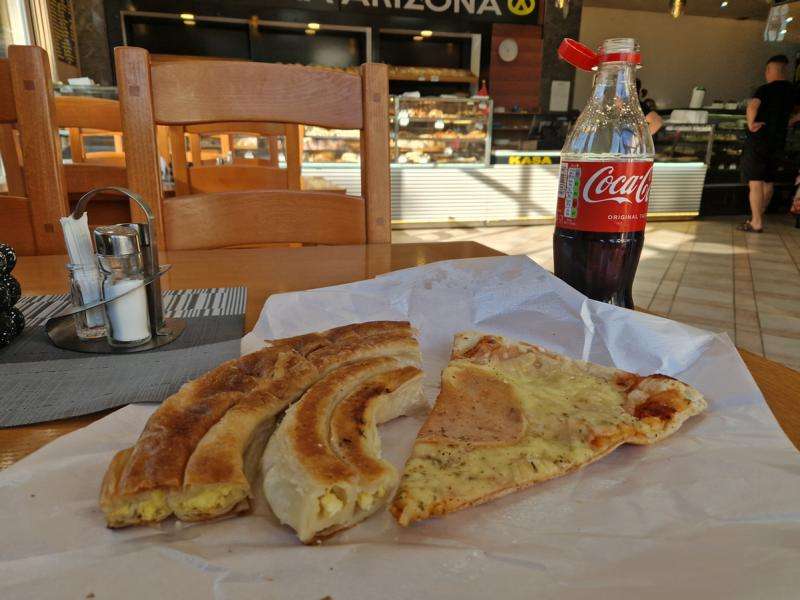
As soon as I cross the border into Bosnia and Herzegovina, I notice something else: there are a striking number of minarets in the villages. Again and again I hear the call to prayer – a soundscape that immediately tells me I have entered a different world.
Mostly men are out on the roads. It is Saturday evening, and apparently some of them are in quite a hurry. Cars keep flying past me at rather impressive speeds.

I am relieved when, just after Suha, with darkness already setting in, I can finally turn onto a gravel road. I hadn’t expected this at all – but at least I’m off the main road.
Finding somewhere to sleep is difficult. I would actually like to get over the mountains, but earlier I had spotted a nice little spot near a hut. I thought I would ride a little further.
Now there is simply nothing.
My surprise gravel road takes me over a small mountain towards Banovići. Only later do I realise that, with a few extra kilometres, I could have taken an asphalt road and probably arrived much faster.
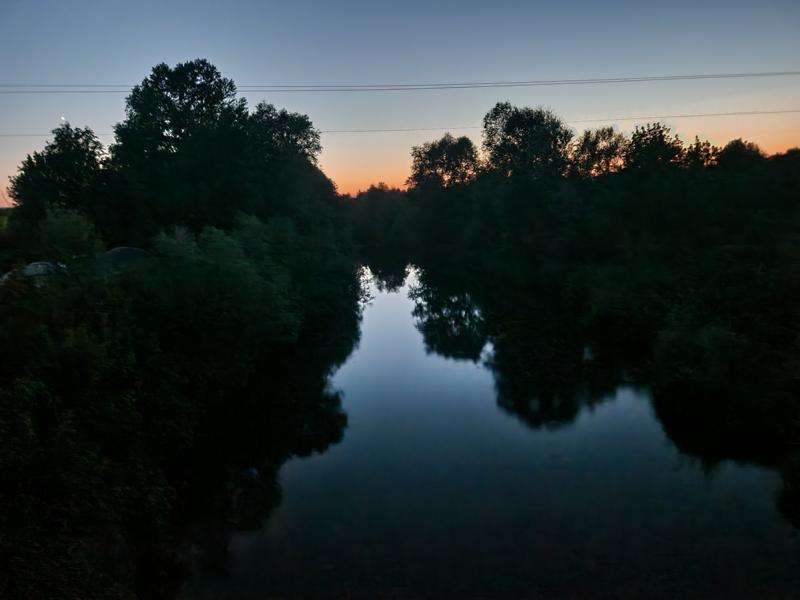
Instead, I have about five kilometres of gravel – and I have to push for almost half of them. It is completely dark and rather eerie. The stream rushes beside me, but I can barely see anything.
Suddenly a large black shape appears ahead. As I get closer, my headlight reflects off it. I stop – and, of course, my light goes out too. Apparently, the hub dynamo doesn’t produce enough power at walking pace. Wonderful.
I switch on my helmet light. Now I can see what is in front of me: the stream has turned the entire path into a large pool of water. There is no way across without getting my feet wet.
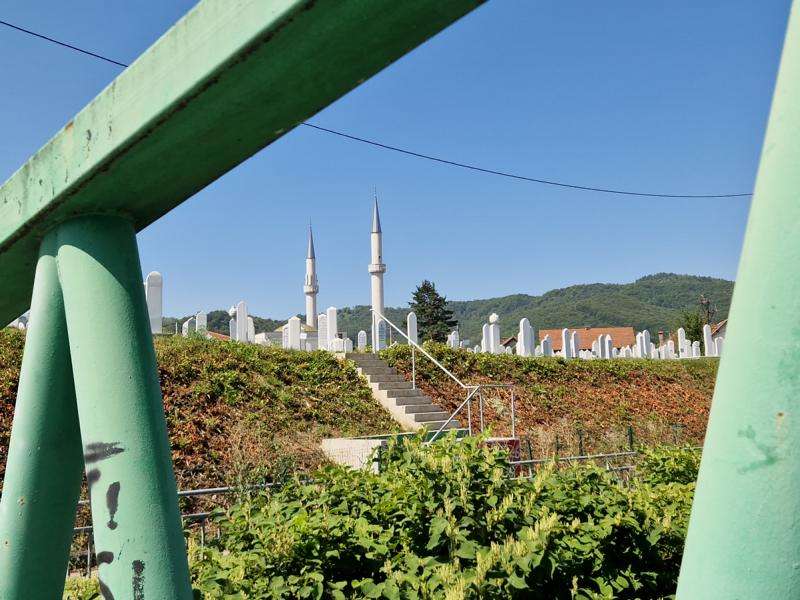
So … in I go. Wet shoes. Again. And the whole performance repeats itself several more times. Where the path is dry, it is so steep that I can’t ride. So I keep pushing through the darkness. It takes me more than an hour and a half.
As I walk, I keep thinking about the road from the border to roughly Tuzla. It was a nightmare: enormous amounts of traffic, poor road surfaces and, along the edge of the road, often a raised ridge of asphalt. Getting caught on that while the bike starts wobbling and a lorry is coming past … I don’t even want to think about it.
Several times things got really close. Once there was a wide lorry heavily loaded with hay bales. If I hadn’t moved onto the shoulder in time, the load would probably have knocked me over. Other vehicles thundered past so closely that I could almost have touched them with my elbow. Others raced past at incredible speed. They certainly wouldn’t have been able to stop quickly if something had suddenly appeared in front of them.
And while I am now cursing this godforsaken gravel road in the dark, I suddenly think:
Actually, I should be grateful to be here at all. And I am.
I had thought I was the only one who had chosen this gravel section. I was wrong. Suddenly I see a light behind me and Marius overtakes me – as always, very quietly.
Banovići is buzzing. Saturday night fever! Young people are out, some cruising around in their souped-up cars and motorcycles. I’m worried about being overlooked again, so I switch on my second flashing rear light just to be safe.
And it isn’t only people who are out. Suddenly a whole pack of skinny dogs is standing in front of me. I brace myself for the next spectacle – but these gentlemen don’t take the slightest bit of notice of me. They simply let me pass.
Maybe I’m lucky and it will stay that way.
Soon the road climbs into a dense forest. This would be exactly where I would like to find somewhere to sleep. But there is simply nothing suitable. No forest track, no clearing, no hidden spot.
Twice I think I have found somewhere – and then I hear angry dogs barking. So I carry on.
Eventually there is a long descent. And suddenly I’m cold. Down from the little pass towards Ribnica, and then into the valley of the Krivaja.
Finally, at a small parking area beside a house, I take the risk. I put up my tent. It isn’t exactly beautiful here – the place is littered with rubbish. And I doubt I’ll get much sleep.
I’m a little nervous because I can hear voices on the other side of the fence. So I do everything as quietly as possible. When I finally lie down in the tent, I hear two men walking past.
I hold my breath. They move away, chatting casually as they go. And then … sleep takes over.
I don’t get much of it, though. Four hours – still one hour more than the night before, when I slept before the Danube ferry.
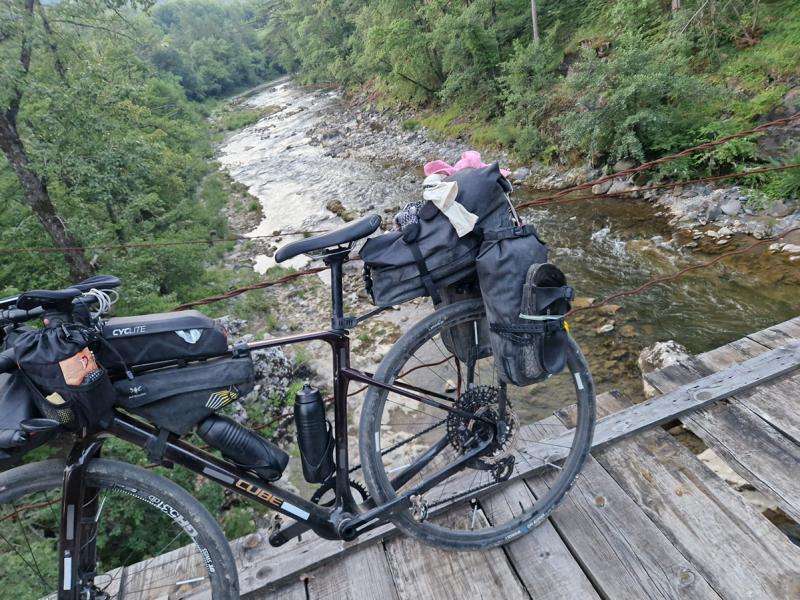
Day 14, Sunday, 2 August
250 km | 3,130 m elevation gain | 15:30 h
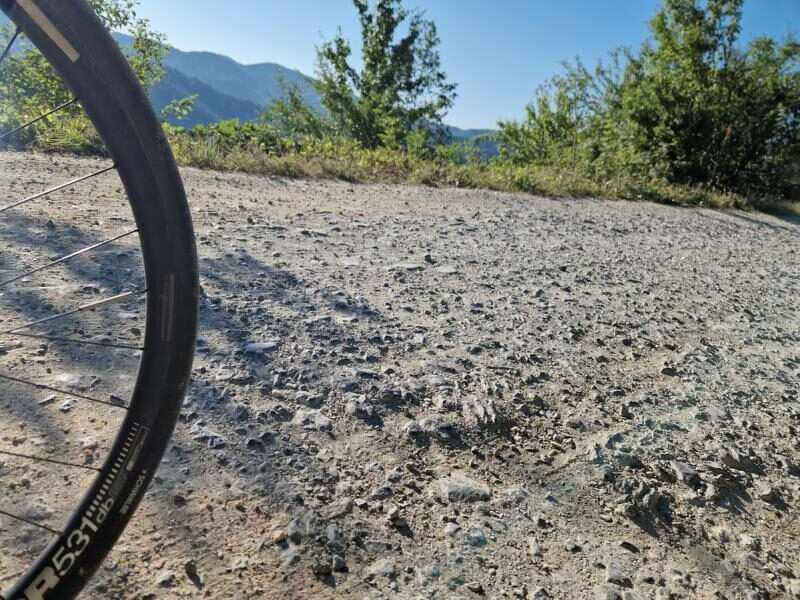
I’m back on the road shortly before four and follow the Krivaja upstream for about 20 kilometres. It’s a beautiful area, with a campsite along the way and several fountains where I can refill my water. Then, suddenly, I have to turn right – and that means two unexpected gravel sections of about four kilometres each. Of course, both are uphill. I struggle my way through the forest, passing the small hamlets of Donja Vijača and Ivančevo. Along the way, I take a short maintenance break: some sunscreen for me and some oil for the chain. The chain is looking pretty miserable by now and could definitely use some attention. After the second gravel climb, I finally reach asphalt again. At last! From here, I roll downhill into the Stavnja valley.
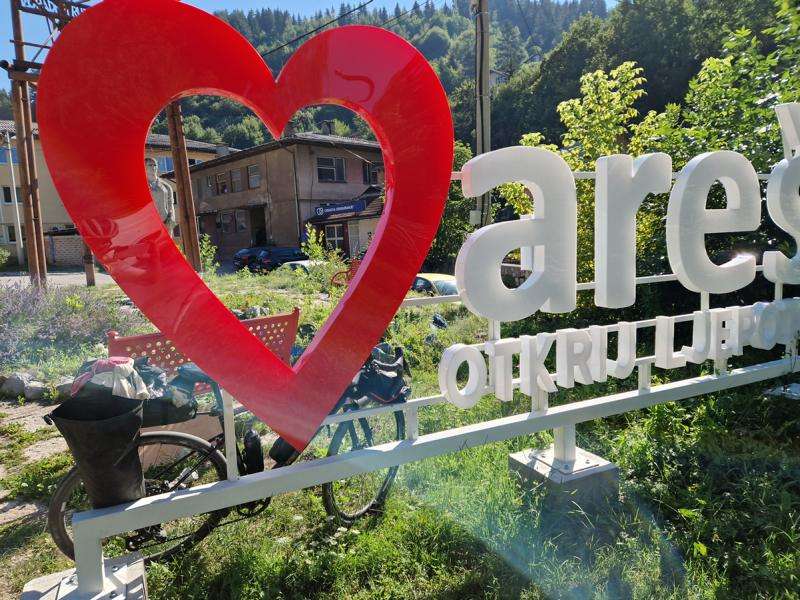
Before reaching Vareš, I pass through a rather unusual tunnel. A sign warns: “SMANJITE BRZINU – ŠIŠMIŠI U LETU.” Literally: “Reduce speed – bats in flight.” So, slow down – bats ahead. I’m doing that anyway most of the day… In fact, this road doesn’t simply pass through a mountain; it runs through the Ponikva cave. Several rare species of bats live in this natural cave system. Quite a special way to enter Vareš!

In Vareš, it’s time for breakfast at a small bakery: a sweet pastry and some Turkish yoghurt, which has by now become almost a fixed part of my breakfast routine. And, of course, a canned cappuccino. There’s not much time to linger, because a long downhill stretch awaits me. For almost 30 kilometres I can simply roll out of Vareš towards Breza. Shortly afterwards, an Edeka petrol station offers the temptation of a second breakfast. Apparently, one wasn’t enough.
In Vareš, I notice the many old, partly abandoned brick buildings. They almost look like a ghost town. A little research reveals that they are remnants of the former ironworks and mining facilities. Vareš was once an important centre for iron ore mining and iron production. In 1891, the first blast furnace in Bosnia and Herzegovina was built here. Today, the abandoned industrial buildings look like relics from another era.
Then there’s another dog sprint. The road is slightly downhill, the barking dog comes fast – but I’m faster. My heart rate nevertheless shoots up noticeably. For some reason, dogs seem to take my athletic ambitions particularly seriously.
I then follow the Bosna valley towards Sarajevo. The closer I get to the city, the heavier the traffic becomes. The quiet roads of the morning gradually turn into a much busier affair. From Vogošća onwards, there are noticeably more cars. Whenever possible, I escape onto cycle paths. Then the road drops down once more towards Kobilja Glava and continues downhill to the Miljacka River.

Just before Sarajevo, however, there is one more little navigation surprise waiting for me. I almost end up on the motorway. I’m still wondering how I could possibly have overlooked this restriction when I suddenly spot the motorway toll booth ahead. Oops! I quickly get off the exit again before my little navigation mistake turns into a much bigger problem.
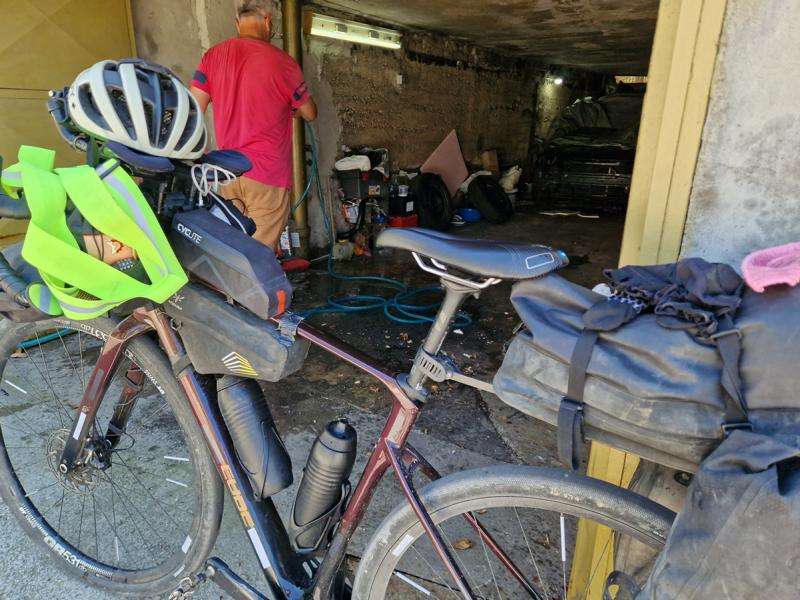
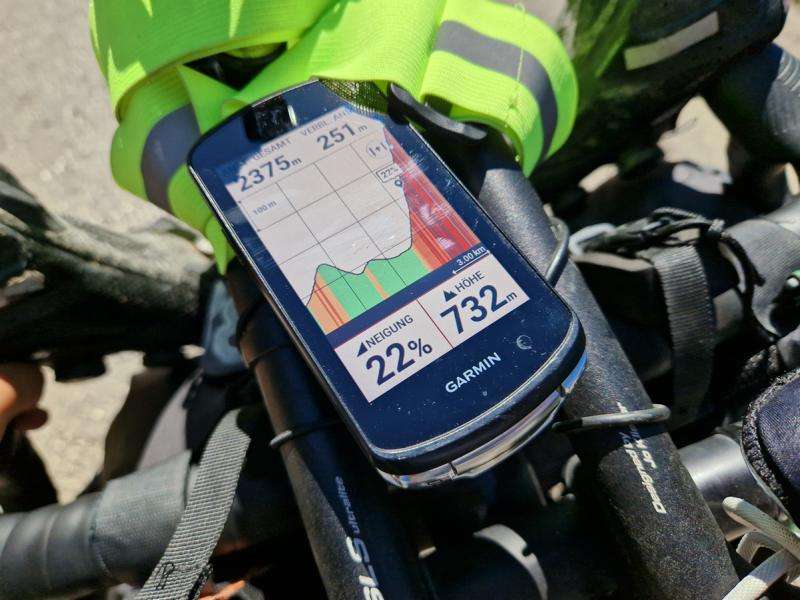
By now, the heat has become unbearable again. And the hardest part is still ahead: the climb via Bistrik towards Trebević and the old bobsleigh track. Some sections are steeper than 20 percent – riding is simply no longer an option.
Luckily, I get a little help along the way. A man lets me use the hose in his garage. I soak myself from head to toe and, for a brief moment, feel almost human again.
Then I continue climbing on narrow roads, eventually reaching Sarajevo’s abandoned Olympic bobsleigh track. The approximately 1,300-metre-long track was built for the 1984 Winter Olympics and now lies hidden in the forest.
I don’t attempt the steep climb in my cycling shoes, though. Instead, I put on my Birkenstock sandals. They may not exactly be standard TCR mountaineering equipment, but at least I have a little more grip.

Once I reach the top, I have to ride back down the bobsleigh track. It’s quite an experience: a few pedestrians are around, and I carefully roll through the old track, beautifully covered in graffiti.
Then comes the less enjoyable part: I have to climb back up the run-out of the bobsleigh track. The further I get, the steeper it becomes. In my cycling shoes, I can barely get any grip on the concrete, and the heavy bike keeps pulling me backwards. Eventually, I’m hanging onto the edge wall with one hand, unable to move forwards or backwards. Letting go is definitely not an option.

Then I hear voices below me. I quietly call out, “Help!” A couple appears underneath me. I hear them speaking Italian and call out again: “Aiuto!” They immediately realise I’m in a bit of trouble. With them pushing from below and pulling from above, we finally manage to get me and the bike safely over the edge.
Once we’re up, we still have to lift my bike about one and a half metres down onto the road.

Saved! Without those two, I might have spent quite some time hanging there, looking rather decorative against the wall.
Then I meet Oliver, and we ride together for a while. Shortly afterwards, I finally reach CP3 – on time, and even half a day ahead of the cut-off. That feels pretty good.
In the late afternoon, I set off again. I still have another 80 kilometres to ride before I find myself somewhere to sleep. The day isn’t quite over yet.
← Back to the TCR overview with all stages
Next: CP3 to CP4 (Albania) →


